
Arranging a long or very narrow room: tips and décor tricks
Arranging a long bedroom can seem complex. Between space constraints and the risk of visual imbalance, this layout requires clever choices to combine comfort, aesthetics, and functionality. Regardless of your room's specific layout—whether it is simply elongated or particularly narrow—there are plenty of practical solutions available to optimize every square meter while maintaining a harmonious atmosphere. Discover how to transform this type of bedroom into a cozy haven that feels both spacious and welcoming, thanks to the right layout and decor tips.
From the very first arrangements, choosing an appropriate furniture makes all the difference. Small storage units, such as a small bedroom furniture, help optimise narrow spaces while preserving a natural flow of movement.
Structure the space to balance the volumes
In a narrow or elongated room, the first step is to master the geometry of the space. A disproportionate area requires a carefully considered distribution between the resting area, storage, and passage.
Define clear functions
Each metre must be utilised for a specific purpose: sleeping, preparing or storing. It is therefore better to start with an observation of the fixed points: windows, doors and radiators, which influence the placement of furniture.
One solution is to place the bed in the width direction, where the room layout allows, which helps to rebalance the proportion between length and width. Conversely, in a room with a width less than 2.10 m, it is better to position the bed along the length and use a minimalist headboard to avoid obstructing circulation.
Create a visual opening effect
To break the sensation of a "corridor", focus on optical illusions by playing with colours, patterns, and perspective effects:
- Paint the back wall in a darker shade to visually reduce the length.
- Choose vertical curtains or long sheers that extend the perception of height.
- Incorporate a mirror on the side wall, ideally opposite a natural light source, to accentuate depth while diffusing reflections.
Choose Suitable Furniture for a Long, Narrow Room
The choice of bedroom furniture influences the flow of the layout. In a elongated space, the furniture should lighten the crowded areas and provide multiple functions without disrupting the visual balance.
Prioritise low-depth furniture
Some compact elements (15 to 35 cm deep) are sufficient for everyday storage: small chests of drawers, wall-mounted bedside tables, or even storage benches at the foot of the bed. These models facilitate movement while adding storage areas. Modular furniture is particularly relevant here:
- Sliding panels for mirror doors to visually enlarge the room;
- Headboards with integrated storage (shelves or niches);
- Folding workbenches or consoles serving as a dressing table in the morning and a workspace in the evening.
Exploiting the atypical areas
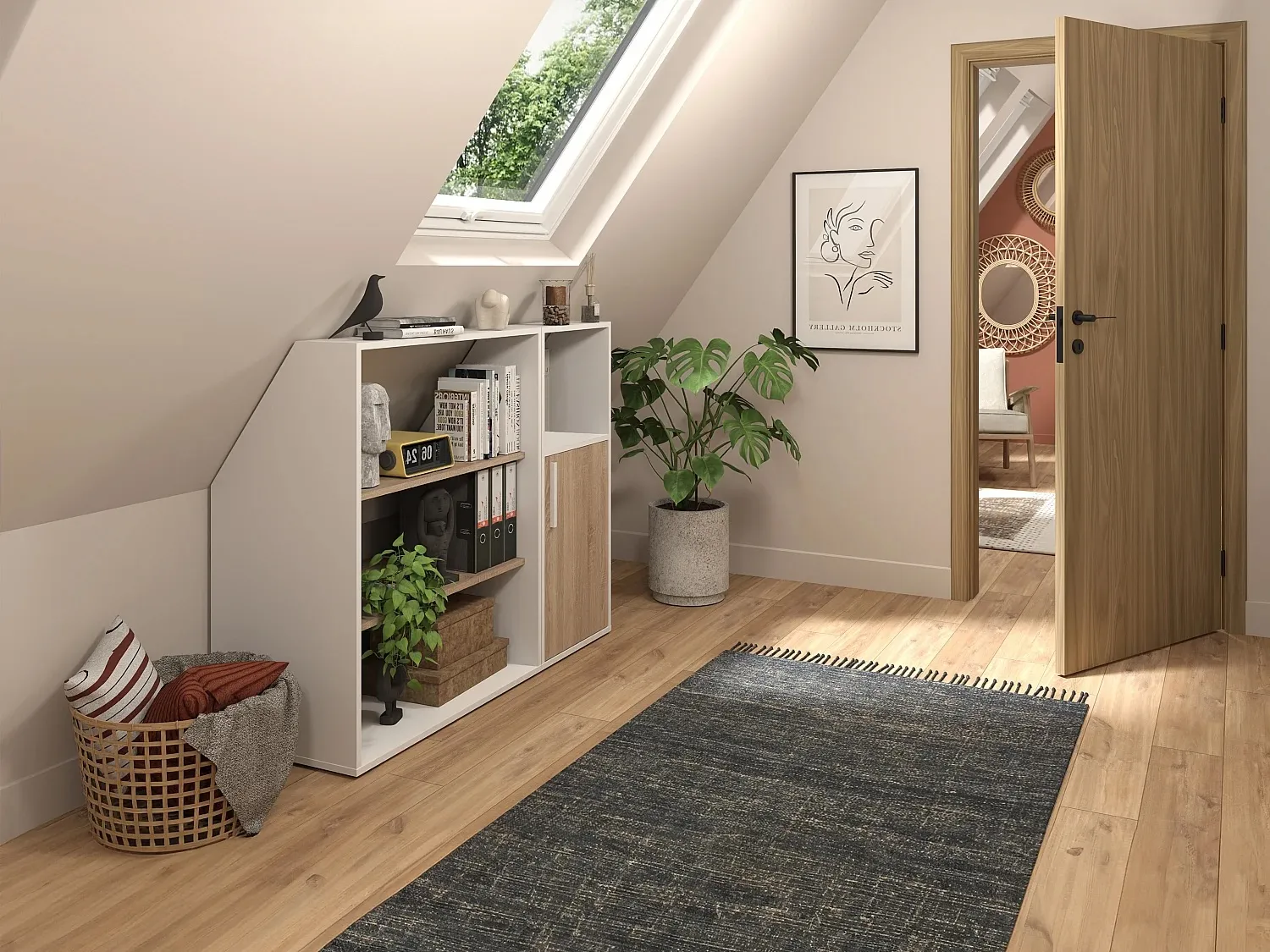
In a attic room or eaves space, every corner hides an opportunity for planning. A sloped ceiling furniture fits perfectly under a lower part of the roof while maximising vertical space elsewhere.
By incorporating this type of custom or adjustable furniture, you turn an architectural constraint into a ergonomic advantage. It’s better to measure the useful height accurately (often between 80 and 110 cm) to choose the most proportionate piece of furniture.
Harmonise the choice of colours and materials
The colour palette plays a crucial role in the perception of the space. Poorly matched tones can accentuate the corridor effect, while a balanced combination restores breath and warmth to the room.
Bet on the light and matte shades
Pastel shades, blonde or linen naturals diffuse light and enhance the sense of space. Matte finishes prevent excessive reflections, which are often unpleasant in a confined space.
For example, you can associate:
- A chalky white on the side walls and a sandy beige on the back wall.
- Textiles (bedspreads, cushions, throws) in shades of pearl grey or powder pink to soften the atmosphere.
- A light floor (whitewashed parquet, light oak laminate, or cream-coloured carpet) to reflect light and enhance the sense of space.
Introduce some contrasting accents
To structure the whole without heaviness in the appearance, some dark or subdued touches create rhythm: a headboard made of walnut wood, a graphic rug with vertical stripes, or a golden lamp. These elements punctuate the length without making it feel longer. At the same time, the choice of materials should favour lightness: light wood, thin metal, transparent glass. These airy textures bring elegance and fluidity.
Smartly Illuminate a Long Room
A very narrow or elongated room often suffers from a lack of light, especially if the window only covers part of the end. The solution is to multiply the sources to balance the shadowed areas and avoid overly stark contrasts.
Multiply the light points
To enhance each area of the room and avoid shadowed zones, it is better to combine different lighting atmospheres rather than just relying on a simple central ceiling light. The idea is also to play with various lighting atmospheres by installing multiple types of lighting:
- Wall-mounted adjustable lamps on the sides of the bed to replace the bedside lamps;
- LED strip behind a shelf or a mirror to create indirect and gentle lighting;
- Discreet pendant light, elongated along the main axis of the room to guide the eye.
Enhance the natural light
If the room has only one gable window, opt for light and airy curtains. Avoid thick drapes or dark tones, which can compress the perception of space. You can also install a mirror or an interior glass partition to allow the light to "travel" across the gable window, reaching the back of the room.
Optimise the storage without reducing the room size
Storage is essential for maintaining clarity in a narrow space, but their arrangement must be strategic. Too bulky, they clobber the perspective. Too scattered, they fragment the flow of the room.
- Utilise the Height : in a long room, vertical space is your best ally. Full-height wardrobes (up to 240 cm) offer maximum capacity without encroaching on the width. However, sliding doors are preferable to avoid obstructing circulation.
- Combine with Hidden Storage : the bed with storage compartment, the lift-up bench or the drawers beneath the bed allow you to hide away out-of-season laundry or accessories without cluttering the visible space. This approach promotes a clean, pleasant decor.
- Use the Side Walls : floating shelves or suspended rails optimise otherwise unused surfaces. You can place books, picture frames or decorative baskets on them. To maintain visual continuity, align the shelves at mid-height and paint them the same colour as the wall. This surface-unified effect makes the space feel larger.
How to succeed in decorating and choosing textiles?
Decorating is the finishing touch that transforms an atypically sized room into a harmonious space. In a narrow room, it remains essential to play on lightness and the coherence of patterns to avoid any sense of visual overload.
A simple style, warmed up with some natural notes, works especially well in a long bedroom. By favouring light wood furniture, linen bed linen, and rattan or glass lighting fixtures, each element helps to create a soft, enveloping atmosphere conducive to rest. Textiles then become genuine tools to structure the room. A rectangular rug properly placed helps to define the sleeping area, while a voile with vertical stripes emphasises the sense of height. Colourful cushions or a duvet cover with geometric patterns introduce rhythm and break the monotony of a very linear volume.
A few targeted decorative touches are then enough to add depth without weighing down the overall space. A vertical picture, a hanging plant or a floor lamp with slim lines bring character while subtly guiding the gaze from side to side of the room, which helps to soften the corridor effect.
Some tips to make the room more welcoming
For a long or very narrow room to maintain its welcoming appearance, comfort and aesthetic coherence must be combined. A few adjustments are enough to transform a disproportionate space into a genuine retreat.
- Prioritise Partial Symmetry: two identical lamps on either side of the bed, but offset to allow the volumes to breathe.
- Introduce Plants to add natural dynamism (bonsai ficus or hanging ivy).
- Create a Sitting Area, Even a Small One: a round pouffe or a low bench to give the impression of a multi-functional space.
- Choose Accessories with Vertical Lines to rhythm the length without emphasising it.
Thanks to these well-considered adjustments, the room gains in balance, comfort, and personality, without compromising its usable space.
Thinking about the layout in its entirety
Arranging a long or narrow room primarily requires coherence. Each choice must fit within an overall logic: placing the volumes smoothly, balancing the heights of furniture, and playing on the complementarity of materials and lighting.
By integrating custom solutions and compact furniture, a narrow or elongated room becomes a truly functional and aesthetic space. The goal is not to hide the constraints, but to transform them into a decorative potential: an extended wall becomes a graphic support, a window at the end of the room becomes a focal point, and every element naturally finds its place.
