
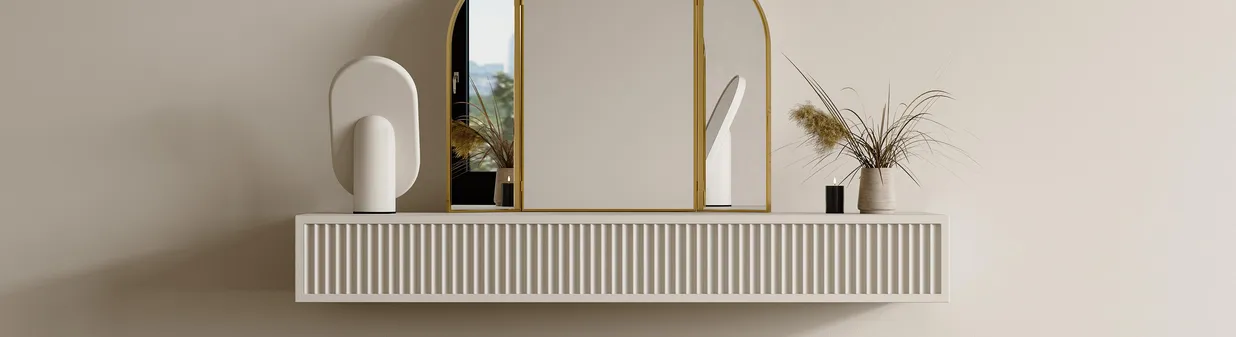
Art Deco mirrors: how to recognise them and use them in your decor
Among the decorative objects that span the decades without ever losing their splendour, the Art Deco mirror holds a special place.
Born in the 1920s and 1930s and popularised after the International Exhibition of Modern Decorative and Industrial Arts in Paris in 1925, it combines geometric lines, symmetry and precious materials. Whether it is a vintage Art Deco mirror inspired by the 1930s or an updated contemporary large Art Deco mirror, these models bring character and structure to any interior. Even the Art Deco mirror for the bathroom, designed to withstand moisture, elegantly combines style and practicality.
The DNA of Art Deco: a legacy of the 1920s and 1930s
Before looking at mirrors, it is essential to understand what defines Art Deco. This artistic and decorative movement emerged in the 1920s as a reaction to Art Nouveau, which was considered too exuberant and sinuous. Art Deco celebrates a luxurious modernity: strict geometry, visual rhythms, polished surfaces, gleaming bevels and a preference for fine materials such as brass, chrome, glass, marble and precious woods.
Unlike the organic curves of Art Nouveau, Art Deco favours bold, stylised shapes, structured simplicity and a sculptural effect in the space. Mirrors from this period perfectly reflect this aesthetic, combining elegance and practicality.
Today, rediscovering this style in our contemporary interiors means adding a touch of retro glamour that remains perfectly current.
How to recognise an Art Deco mirror
A vintage Art Deco mirror stands out through precise aesthetic codes inherited from the 1920s and 1930s. The first signature lies in its straight, clean, geometric shapes. You will often find slender rectangular mirrors, elegant octagons or arches that soften the lines while keeping a strong structure. Some models go further by combining several shapes in a single composition, creating a real graphic play that instantly catches the eye.
Materials are another essential clue. Art Deco mirrors favour bevelled glass, which catches the light and adds a refined touch. Frames are often made of gilded brass, black metal or dark wood, highlighting the contrast between elegance and sturdiness. Some Art Deco mirrors also feature inlays or patterns inspired by architecture and nature, typical of the 1930s, adding a craftsmanship dimension to their design.
But beyond its shapes and materials, this style is defined by its subtle balance. An Art Deco mirror draws the eye, structures a space and has strong decorative power without ever going overboard. It is precisely this combination of refinement and restraint that makes it a timeless, sought-after piece, able to span the eras while keeping its original elegance.
Why add an Art Deco mirror to your interior decor?
Beyond its recognisable look, an Art Deco mirror fulfils several valuable functions. By nature, it makes a space feel bigger and reflects light, but it also acts as a true ornamental piece.
A large Art Deco mirror in a living room or dining room becomes a focal point that instantly grabs attention. In a bedroom, it adds a note of refinement and reflects natural light to create a calming atmosphere. As for the Art Deco mirror for the bathroom, it turns a practical space into a true design room, worthy of a Roaring Twenties boudoir.
Choosing this type of mirror also means choosing a timeless object. Unlike accessories too closely tied to passing trends, it outlasts fashions without losing its splendour. It is therefore a lasting decorative investment and a way to give your interior extra soul and character.
The different formats and uses of Art Deco mirrors
One of the main strengths of Art Deco mirrors is the variety of their formats, which lets you adapt them to every space. In a hallway, a small vintage Art Deco mirror above a console table welcomes visitors elegantly and immediately sets the tone.
In a living room or bedroom, a large 1930s mirror placed above a fireplace or a bed becomes a true decorative work. A large Art Deco mirror is particularly effective at making small spaces look bigger. Placed opposite a window, it catches the light and gives the room unexpected depth.
Finally, the Art Deco bathroom mirror combines the elegance of geometric lines with practicality. Picture a bathroom with white metro tiles, where a gilt-framed mirror reflects the light from the wall lights: the space becomes a refined, theatrical place worthy of a luxury hotel.
Pairing an Art Deco mirror with your interior decor
A vintage Art Deco mirror is not just a practical object; well styled, it becomes a true focal point in a room. To reveal all its beauty, pair it with decorative elements that highlight its refined, graphic spirit.
For example, a large bevelled mirror above a sideboard looks majestic when accompanied by colourful vases, modern sculptures or brass wall lights that echo its metallic finishes. To emphasise the 1930s feel, you can complete the composition with a geometric rug and a few graphic cushions that echo the bold lines of Art Deco style.
But the Art Deco mirror is not limited to retro interiors; its balanced design makes it surprisingly versatile. In a contemporary setting, it structures the space and adds depth through its reflections and bold lines. In a Scandinavian interior, a bevelled mirror with clean lines goes well with light woods and soft textiles. It can also fit into an industrial style: leaning against a brick wall and paired with black metal furniture, it softens the austerity of raw materials. Finally, in a boho-chic atmosphere, it contrasts nicely with textured rugs, hanging plants and natural materials, creating a subtle balance between geometric precision and a relaxed spirit.
The Art Deco mirror: care and durability
Choosing an Art Deco mirror also means learning how to preserve its beauty over time. Regular care keeps the glass shining, the bevels crisp and the fine materials of these iconic pieces looking beautiful.
Regular dusting with a soft or microfibre cloth is enough to prevent dust from building up and dulling the reflections. To clean the glass, use a specific glass cleaner, applied to the cloth rather than the surface, to avoid drips that could seep into the frame. The bevels, characteristic of Art Deco mirrors, benefit from careful cleaning to keep their shine and play of light.
The frame deserves particular attention depending on its material. A metal frame (brass, copper or blackened steel) should be protected from moisture and cleaned with a cloth lightly moistened with a suitable product to prevent oxidation. Dark wood or fine veneer frames, typical of Art Deco, are ideally nourished with a natural wax that maintains their patina and prevents drying out.
To ensure your mirror lasts, also think about where you put it. Avoid areas exposed to direct sunlight, which could fade the frame or cause warping, as well as damp rooms without ventilation, which encourage corrosion and black spots on the mirror's silvering. Secure fixings suited to the weight of the mirror are also essential to guarantee safety and extend its life.
The Art Deco mirror, a centrepiece to elevate your interior
Whether it is a small hallway mirror, a 1930s mirror above a fireplace, a large Art Deco mirror in the living room or an Art Deco bathroom mirror in a private space, each model has the power to transform a room.
Choosing a vintage Art Deco mirror means choosing an object that combines practicality, beauty and history. Every day, it reflects the light, but also part of your personality. As well as making the space feel bigger, it gives your interior a prestigious dimension that impresses your guests while brightening up your daily life.
Ultimately, an Art Deco mirror is not just an accessory: it is a centrepiece that tells the story of an era, highlights your decorating choices and elevates your living spaces.