
Designing a Safe Nursery: The Complete Guide
Creating a safe nursery means structuring the space around a few key elements: a cot, changing table and practical storage. Suitable, correctly installed furniture helps reduce the risk of falls, bumps or pinching in everyday life. From the outset, choose a baby bed that complies with safety standards, a stable changing table and equipment designed to reduce less obvious hazards such as cables or sockets. With a few good habits, the nursery quickly becomes a reassuring haven for both your child and you.
Choose a safe and comfortable cot for your baby
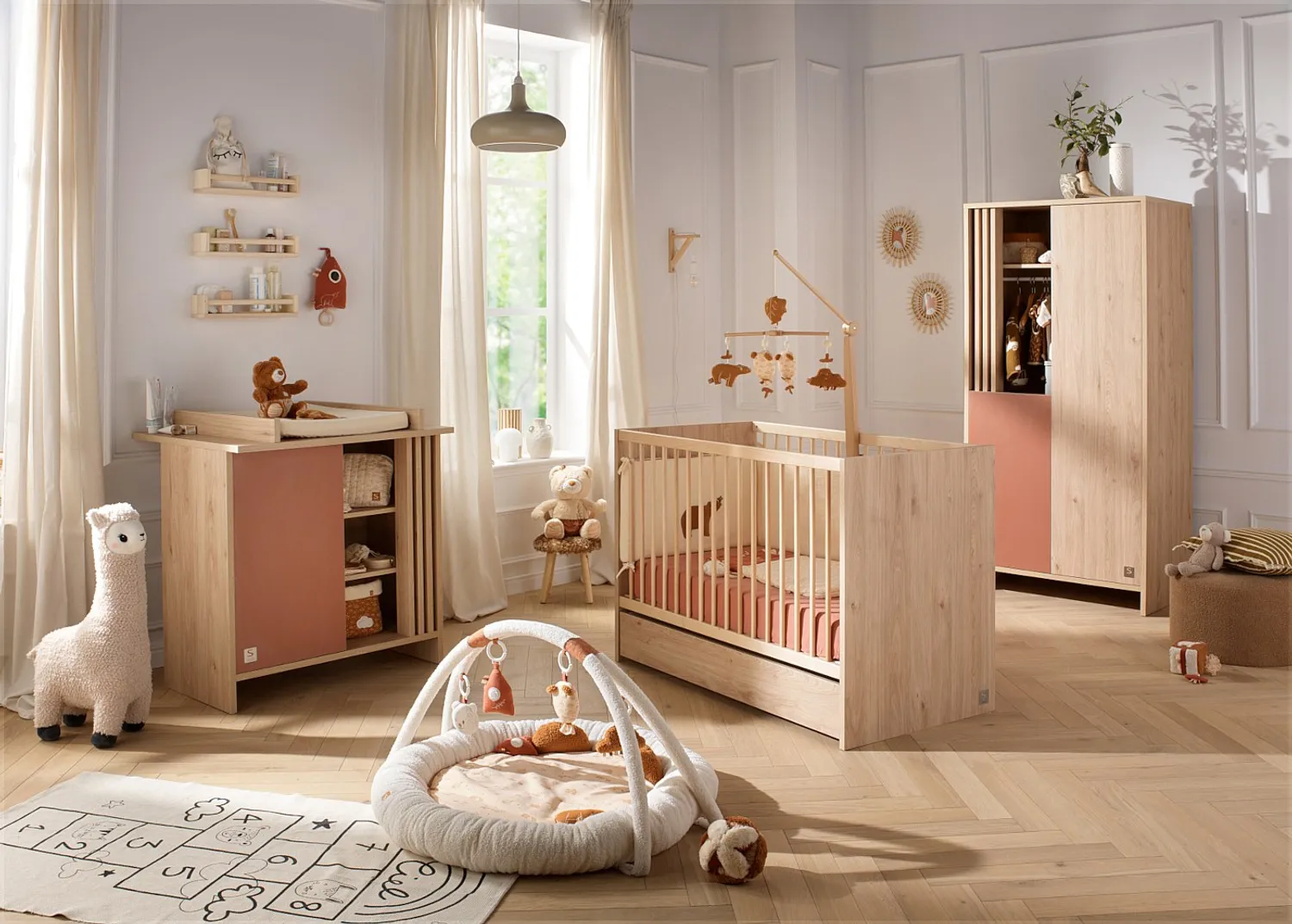
The cot remains the centrepiece of your child’s bedroom. To reduce the risk of falls and entrapment, choose a slatted model that complies with the NF EN 716 European standards, with spacing between the slats of between 4.5 and 6.5 cm, preventing your baby from getting their head stuck between two slats.
The sides must be at least 60 cm high between the top of the mattress and the top of the bars when the bed base is set to its lowest position. This configuration limits the risk of the child climbing over as soon as they sit upright.
The mattress should be firm and fit the cot perfectly, with no gap between the edge and the bars, to prevent the baby from getting a limb trapped or slipping down the side. Choose a new mattress treated against dust mites and covered with a washable cover to maintain a healthy environment. To reduce the risk of suffocation and overheating, replace duvets, pillows, thick blankets or bulky cot bumpers with a baby sleeping bag suitable for the season.
A cot with a height-adjustable base offers greater everyday comfort. You can position your baby at the highest level during the first few months to protect your back, then gradually lower the base when they start sitting up or pulling themselves to stand. When your child moves into a junior bed, adding a cot bed guard helps make this transition safer and reduce night-time falls.
Install a bed rail at the right time
The bed rail for babies becomes a valuable ally when your child moves from a cot to a “big-kid” bed. Once they can climb down on their own but may still fall out in their sleep, this rail helps prevent night-time falls while still allowing them to get in and out of bed in your presence.
To maximise safety, opt for a bed guard covering a large part of the bed’s length, or both sides if the bed is not against a wall. The edges should be rounded, with no protruding parts or small detachable components. If there is any fabric, it should be taut to prevent the child from becoming trapped in it. Also remember to check the tightness of the fastenings regularly, especially if your child tends to lean on it or play on it.
In the bedroom, the guard rail is not sufficient on its own. Avoid placing the bed against a window or near a radiator, and remove any furniture that could be used as a step to climb over it. For access to the room or nearby stairs, you can complement the equipment with a specific safety gate, installed in front of hazardous areas.
Set up a genuinely safe changing table
The changing table is one of the essential items in a baby’s room. However, it is also one of the places where falls occur most often. To limit the risks, choose a stable piece of furniture that complies with the European standard NF EN 12221. This standard governs the safety of changing units and guarantees, in particular, the solidity of the structure and the effectiveness of the side guards. If you opt for a folding model, check that it has a reliable locking system that is easy for an adult to operate but impossible for a child to open.
In practical terms, the changing surface should be wide enough to accommodate a thick changing mat, preferably one with sloping edges or raised sides on several sides. Where possible, position the table in a corner of the room. The two sides will naturally be protected by the walls, reducing the risk of tipping. To further improve stability, secure the table to the wall if the model allows it, particularly if it is a tall chest of drawers.
Safety also depends on your actions. Never leave your child unattended and always keep one hand on them while you reach for a nappy or a product. Organise your storage within easy reach: nappies, cleansing lotion, cotton wool, spare clothes… Everything should be accessible without you having to move away. If you are short on space, a changing mat secured to a chest of drawers or a wall-mounted changing unit are interesting alternatives.
Organise storage for a functional and safe bedroom
A tidy baby’s room is easier to manage day to day, but also safer. Choose low, accessible storage such as chests of drawers with soft-close drawers, shelves at child height, and fabric or wicker baskets for toys. Always secure tall or narrow furniture to the wall, as it could tip over if your child tries to pull themselves up on it. Door restrictors and doorstops also help prevent trapped fingers in draughts.
For clothes and bed linen, using boxes or drawer dividers makes it easy to find everything quickly without leaving objects lying around on the changing table or floor. Always store potentially dangerous items (scissors, glass thermometer, nail clippers, antiseptic solutions) in closed storage units, up high and, if possible, outside the bedroom. Similarly, plastic bags, batteries, small decorations and sewing accessories must never be left within reach.
As your child grows, regularly reassess the room layout. What was out of reach at 6 months may no longer be at 18 months. This regular review is an integral part of creating a safe nursery, just like buying a good baby cot or a suitable changing table.
Secure the nursery’s overall environment
Beyond the furniture, the safety of the baby’s room depends on many details. For the floor, a soft, washable carpet or rugs securely fixed with non-slip systems can help reduce the risk of slipping. Electrical sockets should be protected with dedicated covers, and extension leads should be avoided or stored out of reach. The wires of lamps, baby monitors or humidifiers should be kept out of reach of the cot, as should curtain or blind cords, which pose a strangulation risk. For furniture, opt for low models with rounded corners, possibly fitted with corner protectors and drawer locks to prevent fingers from getting trapped.
Also think about toys: only keep toys that are suitable for your child’s age, carry the CE or NF mark and have no small, detachable parts. A lightweight toy chest or large, open plastic containers are safer than heavy wooden chests. By getting your child into the habit of putting their toys away in boxes or on low shelves from an early age, you make it easier to move around the bedroom and reduce the risk of tripping during night-time trips out of bed.
Control the temperature, lighting and air quality
Safety also depends on thermal comfort and air quality. The ideal temperature in a baby’s room is around 18 to 20 °C to promote peaceful sleep and limit the risks associated with overheating. Avoid portable radiators or portable flame heaters in the room, and position the cot away from heat sources and direct draughts.
Daily ventilation remains essential. Open the window for a few minutes each day to refresh the air, making sure the room is unoccupied. As for lighting, use several sources of soft light rather than an overly harsh ceiling light. A night light or a dimmable lamp, placed out of reach, prevents dangerous handling while reassuring the child. Finally, to limit allergens, clean the room regularly with a vacuum cleaner and mop rather than strongly scented products.
