
How to choose a garden fountain?
Installing a garden fountain immediately transforms the atmosphere of an outdoor space. The sound of moving water creates a soothing sensation, while also giving the layout visual structure. Beyond its aesthetic appeal, a well-chosen fountain blends harmoniously into its surroundings and meets specific technical requirements. It can help create a true relaxation area, conducive to unwinding, by masking surrounding noises such as traffic or neighbours. From the outset of your research, it is essential to explore the different models of garden fountain to identify the one that suits the layout of the grounds and the desired style.
Define the use of the garden fountain
Before considering the materials or dimensions, it is important to determine the fountain’s main function. This choice directly influences the type of installation and the expected performance. A decorative fountain focuses on visual appeal. It becomes a central feature of the garden, often installed on a terrace or at the heart of a flower bed. It can be compact, with a height of between 40 and 80 cm, and prioritises carefully crafted shapes. Some models even incorporate LED lighting, with a power output of between 1 and 5 watts, which highlights the movement of the water at nightfall.
Conversely, a functional fountain serves a specific purpose. It can be used as a water point for watering or cleaning. In this case, it is generally connected to the mains water supply and designed with a practical spout positioned at a height of between 60 and 90 cm above the ground for comfortable use. This type of fountain is particularly useful in kitchen gardens or areas requiring frequent access to water. The choice between these two approaches determines the technical requirements and the ideal location.
Choose the type of fountain according to the available space
The layout of the garden has a major influence on the model to choose. An incorrectly sized fountain can throw the entire landscaping scheme off balance and hinder movement.
The wall-mounted fountain for confined spaces
The wall fountain is installed against a wall or fence. It is perfectly suited to small gardens, terraces or patios. Its depth is generally limited, often ranging between 20 and 40 cm, allowing for easy movement. This type of fountain makes the most of the available space while adding an elegant touch. It fits particularly well into contemporary or Mediterranean designs. It can also be used to enhance a bare wall, adding depth and dynamism.
The central fountain for structuring the garden
A central fountain becomes a focal point. It requires a clear space, with at least 1.5 metres of clearance around it to showcase it properly. Its diameter can range from 60 cm to over 1.20 m, depending on the model. It suits spacious gardens and helps to structure areas visually, particularly as part of a symmetrical layout. Placed at the centre of a path or courtyard, it immediately draws the eye and creates a theatrical effect.
The countertop fountain for greater flexibility
A freestanding fountain does not require complex installation. It can be moved easily and adapts to changes in garden decor. This type of model is often used in flexible spaces, such as patios or balconies. It is an ideal solution for testing different locations before a more permanent installation.
Select materials suitable for outdoor use
The choice of material determines not only the style of the fountain, but also its longevity and the level of maintenance required. Natural or reconstituted stone, resin, fibre-reinforced concrete, steel or aluminium do not offer the same resistance to frost, UV rays or impacts, nor the same visual effect in the garden. Before deciding, it is useful to compare their aesthetic qualities, weight and performance over time to find the fountain best suited to your outdoor space.
The stone fountain for an authentic look
The stone fountain offers a natural and robust appearance. It withstands the weather well and retains its appearance over time. Reconstituted stone models, with an average thickness of between 3 and 5 cm, are lighter while retaining a mineral look. This type of fountain fits perfectly into a traditional or landscaped garden. Over time, the stone may develop a slight patina, enhancing its authentic appearance.
Contemporary materials for a clean, minimalist style
Resin or glass-reinforced concrete fountains are popular for their lightness and variety of shapes. They allow for more modern designs, with clean lines and a range of finishes. Their weight, often under 20 kg for compact models, makes installation easier. These materials also offer good UV resistance, which limits fading.
Metal materials for a designer touch
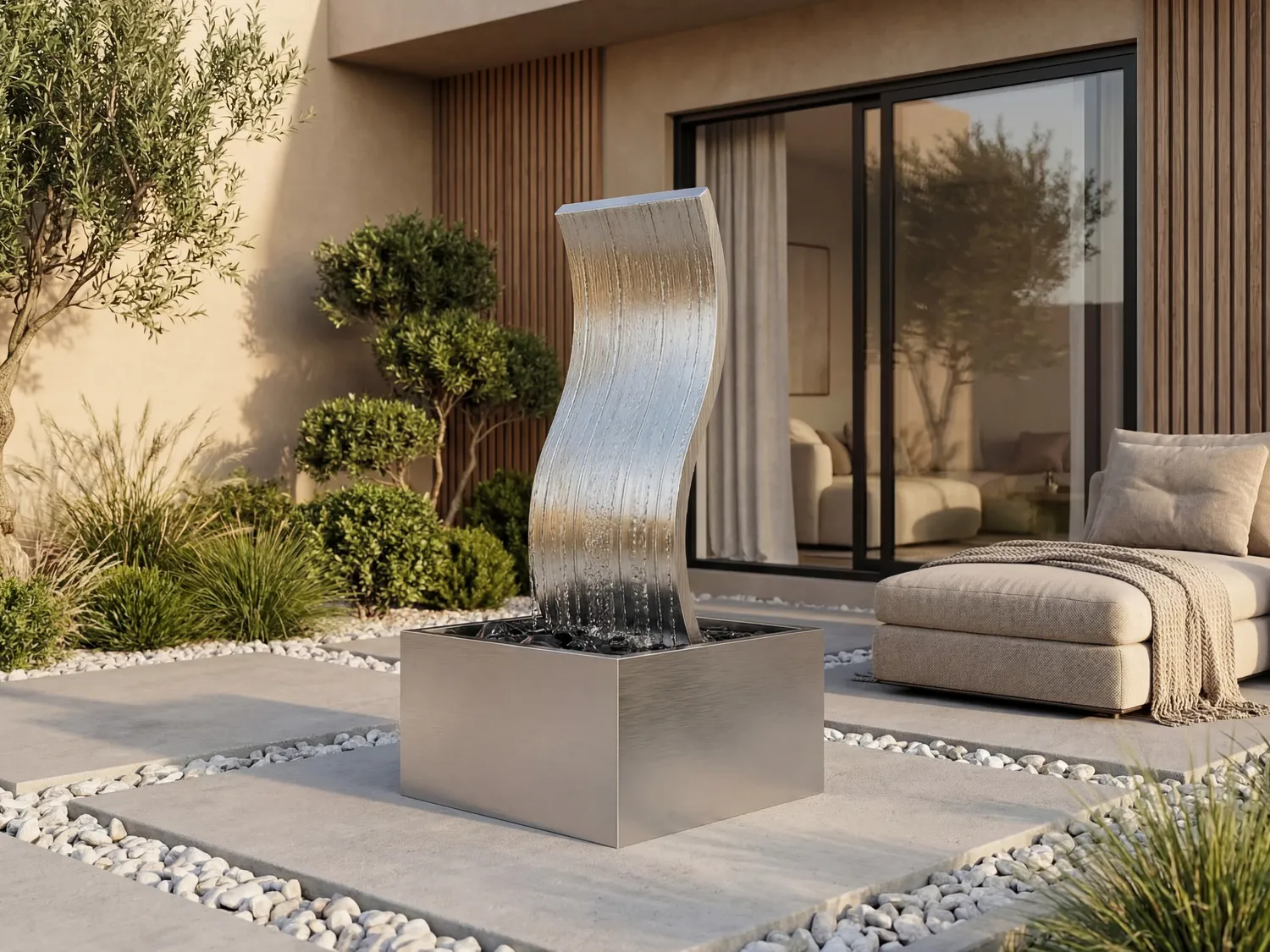
Steel or aluminium create a contemporary aesthetic. These materials require anti-corrosion treatment to ensure their durability outdoors. Their smooth, glossy appearance creates interesting plays of light with moving water.
Understanding How a Fountain Works
How a water feature operates determines its installation, water consumption and maintenance requirements. Depending on the model chosen, the system may be self-contained or connected to the mains water supply, with different technical requirements and uses. Understanding these two operating modes makes it possible to choose a garden water feature suited to your space and needs, while anticipating the practical considerations associated with its everyday use.
The closed-loop fountain for simplified installation
The closed-loop fountain operates independently. Water circulates in a loop thanks to an integrated pump. This system limits water consumption and does not require a connection. The reservoir capacity generally ranges from 5 to 20 litres, depending on the size of the fountain. A pump with a power rating of between 5 and 20 watts is sufficient to ensure smooth circulation. This type of system is particularly suitable for spaces where installing a connection is complex.
The fountain connected for continuous use
A fountain connected to the water supply provides a constant flow rate. It is more suitable for a functional fountain. This type of installation requires a water inlet and drainage, which involves more technical work.
Integrate the fountain into its surroundings
Integrating an outdoor fountain involves more than simply installing it. It should harmonise with the garden as a whole. Choosing the right location plays a central role. A slightly shaded area limits evaporation and algae growth. Positioning it near a living area allows you to fully enjoy the sound of the water.
Combining it with natural elements enhances the visual effect. Plants such as ferns, grasses or aquatic plants create a cohesive setting around a natural fountain. Pebbles or decorative gravel accentuate this look. Adding outdoor lighting directed towards the fountain also helps extend its visual impact into the evening.
Take technical constraints into account
Installing a fountain involves complying with certain technical requirements to ensure it functions properly. The base must be stable and perfectly level. A concrete slab between 5 and 10 cm thick provides a solid foundation for the heaviest models. Access to a power supply is necessary for fountains equipped with a pump.
The pump flow rate must be suitable for the height of the fountain. A jet height of 50 cm generally requires a pump capable of delivering a flow rate of between 300 and 600 litres per hour.
Maintain the fountain to preserve its durability
Regular maintenance ensures the longevity of the fountain and the quality of the water. The basin should be cleaned every two to four weeks, depending on its exposure. Limescale deposits can be removed with suitable products. The pump should also be checked to prevent any blockages.
In winter, it is recommended that you drain the fountain and protect components susceptible to frost. Dismantlable models can be stored under cover.
Harmonise the fountain with the style of the garden
The fountain should form part of an overall vision for the outdoor layout. It becomes a defining feature of the garden décor. In a contemporary garden, a fountain with geometric lines and smooth materials blends in naturally. Conversely, a stone fountain or a natural fountain is better suited to a leafy, organic setting.
The choice of colours, textures and shapes should remain consistent with the other elements of the garden. A well-integrated fountain enhances the visual identity of the space and creates a soothing atmosphere.