
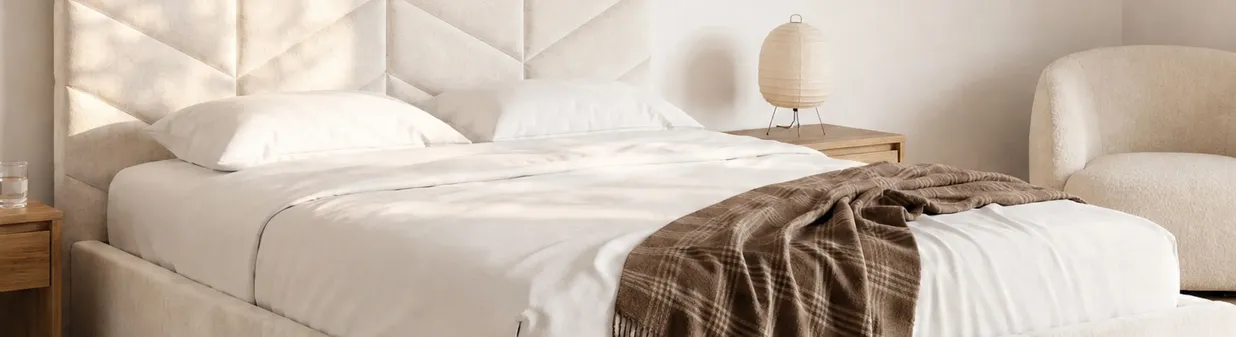
Read aloud in a small room: what compromises should be accepted?
Fitting a double bed in a small room often amounts to a real balancing exercise. Between sleeping comfort, smooth circulation, and storage space, every centimetre counts. The challenge is to find an intelligent compromise without sacrificing either well-being or overall aesthetics. With this in mind, choosing a double bed suitable for the room’s layout is the first crucial step.
Clearly understand the actual limits of your space
Even before selecting a bed, it is essential to precisely analyse the available space. A small adult room typically measures between 9 and 12 m², but this gross figure alone is not enough. The layout of the walls, the presence of a window or door, and the ceiling height all significantly influence the arrangement.
The dimensions of the double bed play a key role here. A standard sleeping area of 140 x 200 cm occupies about 2.8 m², while a model in 160 x 200 cm reaches 3.2 m². In a room of 9 m², this difference may seem negligible on paper, but it clearly affects circulation and the sense of space.
A passage area around the bed should also be included. A minimum clearance of 50 cm is necessary to move around comfortably. When this space decreases, daily activities such as making the bed, accessing storage, or simply moving about become less fluid.
Choose the correct bed dimensions
In a small room, the choice of bed size is not only about comfort but also part of a overall layout strategy. The 140 x 200 bed often appears as the most balanced solution. It allows for a double bed while minimising floor space occupation.
To explore options suitable for this format, you can consult this selection of bed 140 x 200 cm, particularly relevant in confined spaces.
Opting for a wider bed, such as 160 cm, involves more significant compromises. The room can quickly feel overcrowded, especially if it already contains fixed elements like a wardrobe or a desk. Conversely, going below 140 cm can impair comfort, particularly for a couple. The choice thus depends on a clear trade-off: favouring ease of movement or maximising sleeping space. In most cases, the 140 cm size allows for maintaining this balance.
Reduce the bedroom furniture to the bare essentials
The integration of a double bed in a small room requires a careful selection of furniture. Unlike a large space, where you can multiply the pieces, here each piece must serve a specific purpose.
Accumulating a chest of drawers, two bedside tables, an armchair, and a wardrobe quickly leads to a feeling of clutter. The visual space shrinks, and the bedroom loses readability. It then becomes necessary to make choices. Removing a bedside table in favour of a wall shelf, replacing a chest of drawers with an integrated wardrobe, or giving up certain decorative elements can free up space without compromising functionality. This minimalist approach does not mean giving up comfort, but rather optimising each element present in the room.
Transform the bed into a storage solution
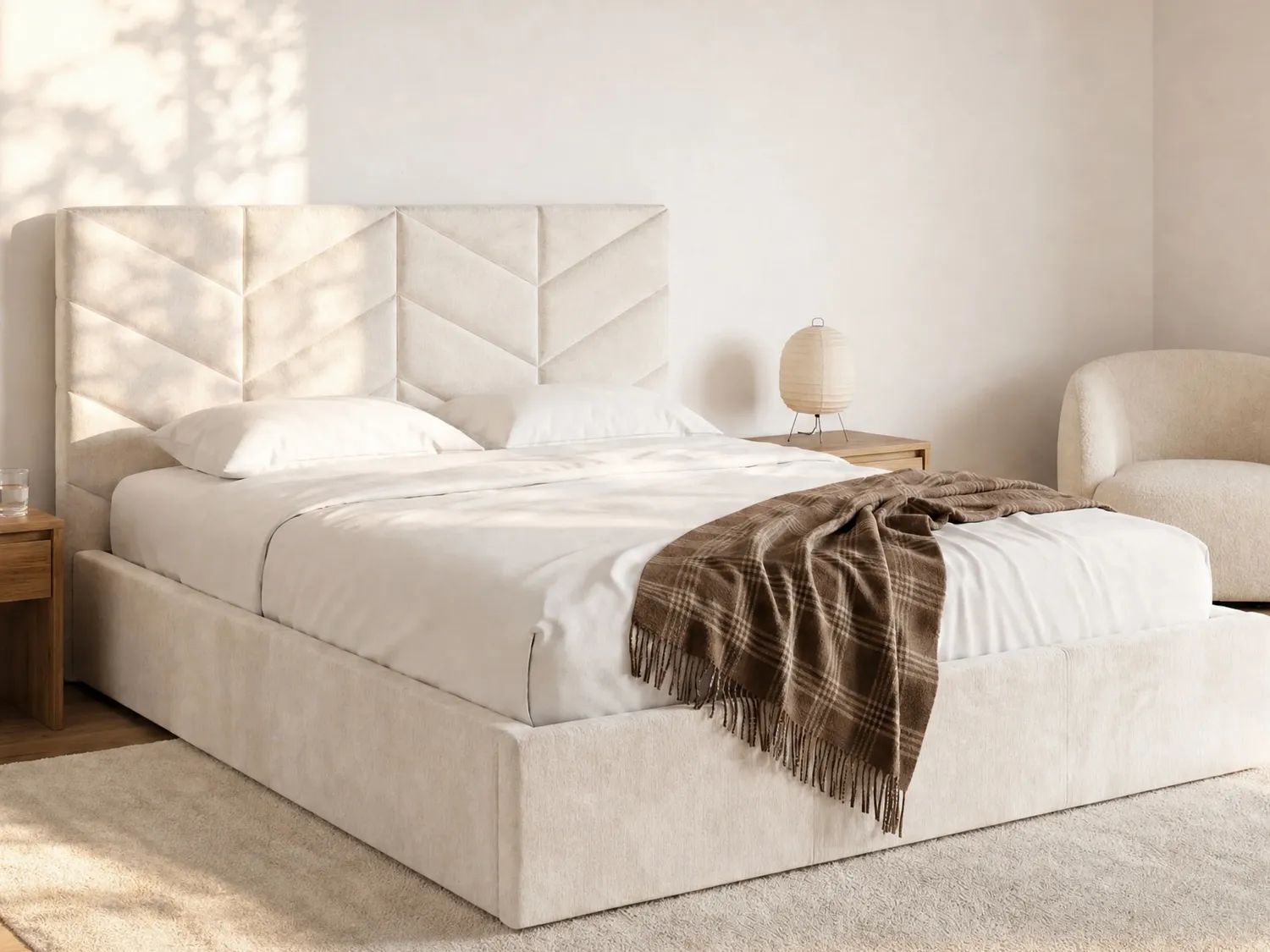
In a limited space, the bed should not be just a simple sleeping area. It can become a true ally in terms of storage. The storage bed or the bed with storage then stands out as a particularly relevant solution.
These models allow you to utilise the space located under the bed, often unused in traditional beds. You can store bedding, out-of-season clothes, or even bulky objects.
The main benefits of this type of bed are:
- Optimisation of available volume without additional floor footprint
- Reduction in the number of pieces of furniture needed in the room
- Simplified organisation thanks to integrated storage space
- Visual discretion with invisible storage solutions
A trunk bed can thus replace a low wardrobe or a chest of drawers, immediately freeing up space to move around.
Rethinking the bed installation
The position of the bed directly influences the perception of space. In a small room, poor arrangement can create a feeling of confinement. Placing the bed against a wall is often the most effective solution. This setup frees up one side and eases movement. However, it does mean that one of the occupants does not have direct access, which is a common compromise.
Installing the bed in a corner can also work, especially in narrow rooms. This arrangement allows for a more ventilated central area. However, it reduces the symmetry of the layout, which can affect visual balance. The bed's orientation should also take openings into account. Blocking a window or obstructing access to a door reduces everyday comfort.
Visually lighten the bed's structure
In a small room, the choice of bed design has a major impact on the perception of space. A solid, heavy-headboard model can quickly dominate the room. Conversely, a lighter framework, with slender lines and visible legs, creates an impression of openness. This type of bed allows light to circulate and gives a sense of volume.
Colours also play a crucial role. Light shades, such as off-white, beige, or pale grey, reflect light and visually enlarge the room. Conversely, dark colours absorb brightness and accentuate the feeling of confinement.
The choice of textiles should follow the same logic. A streamlined bedding, with few layers, avoids heaviness overall.
Exploit the verticality of the room
When the floor area is limited, it becomes essential to use the walls. The furnishing of an adult’s bedroom then involves smart utilisation of height. Wall shelves allow you to free up floor space while providing practical storage solutions. Positioned above the bed or along a wall, they hold books, decorative objects, or everyday accessories.
The high-level cupboards are an interesting option. By extending up to the ceiling, they maximise storage volume without multiplying the furniture. The goal is to concentrate storage upwards to free up the circulation area and maintain a sense of space.
Accept certain comfort concessions
Installing a double bed in a small bedroom necessarily involves some adjustments to habits. These compromises vary depending on each person's priorities, but they often remain unavoidable. For example, access to the bed from only one side may become the norm. This setup simplifies the layout but requires a certain level of organisation on a daily basis. Likewise, the absence of a traditional bedside table forces a rethink of storage solutions near the bed.
The available space for changing or moving around may also be reduced. This requires adopting a more structured routine and limiting unnecessary objects. These compromises remain acceptable as long as the quality of the sleeping arrangement is maintained. A good mattress and an appropriate bed base remain essential to ensure restorative sleep.
Improve lighting to make the space feel larger
Lighting significantly influences the perception of a small room. Poorly distributed light can emphasise shadowed areas and create a feeling of confinement. To avoid this effect, it is advisable to multiply indirect light sources. Wall sconces, for example, free up surfaces while diffusing a soft light. Pendant fixtures above the bedside tables effectively replace traditional lamps.
Well-designed lighting highlights the volumes and helps create a warm atmosphere without overwhelming the space.
Mastering the Decoration of a Small Bedroom
In a small room, the decoration should remain measured. Too many visual elements risk saturating the space and reducing the sense of volume. It is better to limit the number of colours and favour a harmonious palette. Three main shades are usually enough to structure the whole.
Mirrors are an excellent leverage to visually enlarge the room. Placed opposite a source of natural light, they reflect brightness and create an impression of depth. Finally, it is better to favour a few strong elements, such as a large painting or a striking decorative item, rather than an accumulation of small objects.
Furnishing a small bedroom with a double bed is not about stacking solutions, but about creating a coherent whole. Every choice, whether it relates to the dimensions of the double bed, the type of storage, or the layout, should fit within an overall logic. Accepting certain compromises allows you to preserve the essentials: a pleasant, functional, and visually balanced space. A well-thought-out small bedroom can offer genuine comfort, provided that simplicity, optimisation, and coherence are prioritised.
