
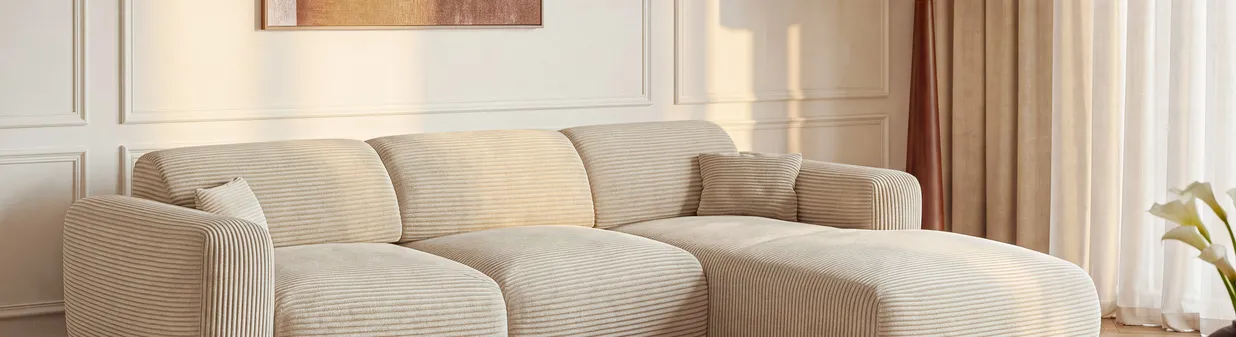
Sofa, divan, couch, chaise longue: what are the differences, and which one should you choose?
Settee, divan, sofa, chaise longue… These terms refer to similar pieces of furniture, but they are not quite identical. Today, “settee” is the most general term for a seat designed to accommodate several people. “Sofa” has become almost synonymous with it, while “divan” originally referred to a bench intended for sitting or resting. The chaise longue is distinguished more clearly by its elongated shape, designed to allow you to stretch out your legs.
The distinction is worth making, especially since the sofa occupies a central place in the layout of the living room.
These different names therefore conceal different origins and uses. Whether it has a backrest or armrests, the seat depth, the possibility of lying down or the space it takes up in the room: here is what you really need to bear in mind before choosing.
"In the living room, the sofa is perceived as the most defining piece of furniture, ahead of sideboards, credenzas and TV units."
Sofa, divan, couch and daybed: the differences at a glance
Term | What it refers to | Key takeaway |
Sofa | A seat designed for several people, available in many different forms | Today, this is the most general and versatile term |
Divan | Originally, a backless and armless bench that could also be used as a daybed | It remains associated with seating intended for relaxation and rest |
Settee | A piece of furniture now very similar to a sofa | The difference between a settee and a sofa lies more in the vocabulary and style than in the structure of the furniture |
Chaise longue | A piece of furniture for resting or, today, an extended seat that allows you to stretch out your legs | Its elongated shape sets it apart more clearly from the others |
The sofa, the most common and versatile term
In French, the word “canapé” has been used since the 17th century to refer to a seat that can accommodate several people. Its origin is nevertheless quite far removed from the piece of furniture we know today: it comes from the Old French conopé, itself derived from the Latin conopeum, which referred in particular to a mosquito net or a hanging installed around a bed.
Over time, its meaning has evolved, and the sofa has become an essential piece of furniture in the living room. The term no longer refers to a specific shape; on the contrary, it encompasses a wide variety of designs, which also explains why it is now used much more often than “divan” or “settee”.
A sofa can therefore be straight or corner, compact or particularly spacious, with a high or low back and slim or more substantial armrests. It can also be fixed or include a sleeping option, such as a sofa bed, which is useful when you want an extra bed without dedicating an entire room to guests.
When choosing a sofa for the living room, the most useful approach is therefore to compare its features directly: dimensions, number of seats, seat depth, firmness, backrest height and upholstery. Two sofas in the same category can offer very different levels of comfort and uses once installed.
The divan, originally a bench without a back or armrests
The word “divan” is borrowed from the Turkish divan, itself derived from the Persian dīwān. Before referring to a piece of furniture, the term notably referred to the sovereign’s council in the Ottoman Empire, as well as to the room in which it met.
These spaces were furnished with low seats and cushions, which explains the word’s gradual shift to referring to furniture. From the 18th century onwards, in French, *divan* refers to a bench without a back or armrests that can be used both as a seat and as a daybed.
Historically, this is what most clearly distinguishes it from the classic sofa. Whereas a sofa is associated with a seat with a backrest and armrests, a divan is more akin to a bench and lends itself easily to a relaxed or reclining position.
Today, this distinction is less strict, and the term “divan” is also used for furniture fitted with a backrest or whose shape more closely resembles that of a sofa. The name alone therefore no longer always makes it possible to know exactly what the piece of furniture looks like.
To make your choice, it is best to look at its design: the height and shape of the backrest, the depth of the seat and the presence of armrests give a much more precise idea of the comfort on offer. For reading or sitting upright for long periods, a backrest offering good support will be more suitable, while a low, open shape will easily find its place in a space dedicated to relaxation.
Sofa and canapé: what’s the difference today?
The history of the word “sofa” follows yet another path. It comes from the Turkish sofa, itself borrowed from the Arabic ṣuffa, which could notably refer to a platform or a bench.
When the term appears in French, it initially refers to a platform furnished with rugs and cushions, and later to a piece of furniture intended for relaxation. Over time, the distinction between it and the sofa has largely blurred, to the point that sofa and canapé now refer to very similar pieces of furniture.
There is no precise technical characteristic that allows a clear boundary to be drawn between the two. In the world of furniture, the word “sofa” may evoke generous lines, deep seating or large cushions, but this image is more a matter of the style associated with the term than a true definition.
A piece of furniture presented as a sofa can therefore have the same structure as another sold under the name settee. When comparing several products, the name used ultimately matters far less than their features.
On a leather sofa, for example, the type of leather, the padding, the seat depth or the shape of the backrest will have a far greater impact on comfort and maintenance than whether it is referred to as a “sofa” or a “couch”.
Seat depth deserves particular attention. A generous seat allows you to settle more easily into a relaxed position or enjoy a comfortable space with others, while a more moderate depth makes it easier to sit upright with your feet resting on the floor.
In practice, therefore, there is no need to look for a difference in form between “sofa” and “settee”: the two terms are now largely interchangeable.
The daybed, a piece of furniture designed for relaxation
The chaise lounge is more easily distinguished from the three preceding terms. Originally, the word referred to the rest or nap taken in the middle of the day, before being used to name a piece of furniture designed specifically for this moment of relaxation.
The traditional daybed is a reclining couch with two headboards of different heights. A prominent feature of 18th- and 19th-century furniture, particularly during the Empire period, it allows you to lie down while keeping the upper body slightly raised.
The term has since evolved with usage. In the world of modern sofas, a chaise longue also refers to an extended seat that allows you to stretch out your legs, particularly on corner sofas and modular models. The original idea therefore remains the same: having a space longer than a standard seat, making it easy to adopt a semi-reclined position.
This is a particularly enjoyable configuration for reading, watching a film or simply relaxing, but its footprint needs to be considered in advance. Unlike a conventional seat, the chaise longue extends into the room and therefore directly affects the flow of movement around the sofa.
Its orientation is also important when it forms part of a corner sofa. It can be positioned on the left or right, while reversible versions make it easier to change the sofa’s layout. Before ordering, measure the available space, taking the coffee table, TV unit, openings and main walkways into account: a few centimetres can make a real difference in a small living room.
Sofa, divan, settee or chaise longue: which one should you choose?
Beyond their history, choosing between these different pieces of furniture depends above all on how you intend to use them and the layout of your home:
- For versatile everyday seating, the sofa remains the simplest choice thanks to the wide range of shapes, sizes and configurations available.
- For a space dedicated more to relaxation, a divan can be an interesting alternative, with a design historically closer to a bench seat or daybed.
- Between a sofa and a divan, there is no need to focus on the name: pay particular attention to the model’s dimensions, seat depth, upholstery and comfort.
- To be able to stretch out your legs, a chaise longue provides genuine space for relaxation, provided you plan ahead for the room it will occupy and its orientation within the room.
Vocabulary therefore helps you better understand the origin and character of each piece of furniture, but it should not become the main criterion when making a purchase. The model’s proportions, its comfort and, above all, how you intend to use it on a daily basis will be far more decisive.
Straight, corner, sofa bed or modular sofa: also discover the different types of sofas and our advice on choosing the ideal model.
