
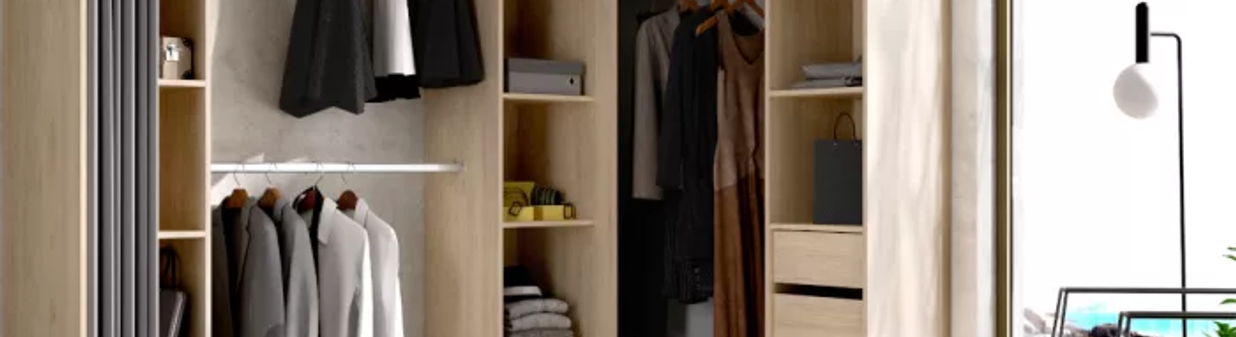
Bespoke walk-in wardrobe: rules to know before starting
Do you dream of a space where every garment finds its place, combining elegance with functionality? A bespoke walk-in wardrobe is not just a luxury; it is an ingenious solution that transforms daily life. It allows you to maximise the available space, whatever the layout of your room, while creating storage tailored to your needs and style. However, designing a walk-in wardrobe requires careful thought, judicious choices, and a good knowledge of the available options. It is a project to be anticipated with care to guarantee a result that is both aesthetic and functional.
What are the essential criteria for a successful design? How can you exploit space intelligently and select the right materials to avoid common mistakes? Discover our practical advice for designing a perfectly optimised walk-in wardrobe, thought out to last and adapt to your lifestyle.
Why opt for a bespoke walk-in wardrobe?
A custom-designed wardrobe perfectly hugs the configuration of your room, whether it is a sloped attic space, an unexploited nook, or a large bedroom. Each element is thought out to integrate harmoniously into your interior, offering a functional layout and a design that reflects your tastes.
The key advantages of a bespoke walk-in wardrobe include:
- Perfect adaptation: It exploits every available centimetre, even in the most complex configurations.
- Total personalisation: Materials, finishes, accessories... Every detail is chosen according to your preferences.
- Flexible evolution: Thanks to adjustable modules and expandable spaces, your wardrobe adapts to your needs over time.
- Intelligent layout: Space is optimised through clever solutions like high-level storage, partitioned drawers, or pull-out rails.
- An asset for your interior: In addition to improving daily comfort, a well-designed wardrobe adds value to your living space.
A bespoke wardrobe is much more than a simple storage unit: it becomes a space that is as structured as it is pleasant to use, and above all, designed to evolve with you. By counting on neat finishes and an ergonomic organisation, every garment or accessory naturally finds its place, making the interior look both tidy and aesthetic.
Essential rules for designing your wardrobe properly
Defining your storage needs
First and foremost, identify the nature of the clothes or accessories you wish to store. Each type of clothing requires a dedicated space to prevent clutter, but also to extend its lifespan. A meticulous assessment of your needs helps avoid mistakes when you want to design a perfectly adapted wardrobe.
For optimal storage, we suggest using tall hanging rails for long garments like dresses and coats. These generally measure between 1.50 and 1.80 m. You can install lower rails for shirts, jackets, or folded trousers, which are estimated between 1.00 and 1.20 m. For underwear or accessories, partitioned drawers will do the trick, but if you are looking for a place to store shoes, bags, and belts, we recommend specific compartments. Boxes or baskets will help you store your smallest or seasonal items, yet you can also use hooks or accessory racks for an optimal organisation of these small elements. Finally, to adapt storage as your needs change, we suggest installing adjustable shelves.
A rigorous analysis of your storage habits will allow you to create a functional and pleasant space to live in, where everything naturally finds its place.
Optimising the available space
Optimising space is essential for designing a functional wardrobe, especially in small rooms. Every centimetre must be exploited intelligently to maximise storage capacity.
Start by exploiting the ceiling height by installing high shelves for seldom-used items, which frees up more accessible space for everyday clothes and accessories. Nooks and difficult spaces can be transformed into practical areas by integrating modular solutions like corner wardrobes or cascading shelves.
Also, make sure to think about accessibility: doors or drawers must open without obstruction to guarantee a fluid and pleasant use. Low spaces must not be neglected either; they can be optimised by integrating sliding drawers, perfect for heavier or less frequently used items. Finally, pull-out accessories will facilitate access to items stored high up, making every element of your wardrobe easily accessible while reinforcing its practical and functional side.
For smaller areas, an extendable wardrobe offers a modular and practical solution that adapts to your space constraints without compromising on aesthetics. This solution allows you to transform even the most complex spaces into optimal storage zones.
Where to install your bespoke walk-in wardrobe?
The location of the wardrobe depends primarily on the available space and how you intend to use it. If it is intended for a couple, it can be set up directly in the bedroom, especially if it connects with a bathroom, thereby creating a true master suite. For a family, it is often more practical to install it in a central space accessible to everyone, such as a small adjacent room or a dedicated alcove.
If you do not have an entire room to transform into a walk-in wardrobe, several solutions exist to optimise unexploited spaces:
- Under a staircase: Perfect for a discreet wardrobe with integrated drawers and hanging rails.
- In a slope or an attic area: Ideal for exploiting ceiling height with adapted storage.
- In a wide hallway: By installing shallow cupboards for space-saving storage.
- In a mezzanine corner: By maximising space with custom shelves and hanging rods.
The key is to lose no square metres and to adapt the layout of the wardrobe to the constraints of the room.
Open or closed wardrobe: which solution to choose?
The choice between an open or closed wardrobe depends on your aesthetic preferences and your level of organisation.
A closed wardrobe protects clothes from dust while hiding potential clutter. It can be equipped with:
- Sliding doors, ideal for small spaces.
- Hinged doors, more traditional but requiring more clearance space.
- Decorative curtains, an economical and flexible solution.
An open wardrobe brings a boutique effect and immediate access to clothes, but requires impeccable organisation. For a harmonious look:
- Arrange clothes by colour or category.
- Use identical hangers for a sleek visual effect.
- Privilege matching baskets or boxes for accessories.
Choosing materials and finishes
Materials determine the durability and aesthetics of your wardrobe. Solid wood brings a warm touch combined with a natural feel, while melamine offers a contemporary style that is easy to maintain. For a more modern touch, glass gives a sensation of lightness combined with elegance.
Do not forget the details that make all the difference: quality handles, hinges, and rails guarantee the furniture's longevity. You can also play with textures and colours for a personalised look. For example, combine light wood shelves with smoked glass doors for a modern and sophisticated aesthetic.
For a more luxurious atmosphere, consider adding metallic finishes like brass or copper, which will bring a touch of sophistication. You can also integrate natural materials like linen or rattan for a sleeker, more authentic style.
Thinking about lighting
Well-thought-out lighting enhances the aesthetics of the wardrobe while making its use more pleasant. It facilitates the selection of clothes and adds a unique aesthetic dimension.
- Integrated LED strips for a soft and homogeneous light.
- Recessed spotlights to illuminate dark corners.
- Fixtures with motion sensors for extra practicality.
- Backlit mirrors to accent brightness and elegance.
Good lighting brings a sensation of comfort and warmth. Remember also to maximise natural light by avoiding blocking windows or by opting for glass doors that let the light through.
Mistakes to avoid when creating a walk-in wardrobe
When designing a bespoke wardrobe, several mistakes can compromise both the functionality and aesthetics of the space.
The first common mistake is neglecting ventilation. A poorly ventilated wardrobe can lead to moisture buildup, promoting bad odours and the deterioration of clothes. It is therefore essential to install air vents or ventilation systems to ensure optimal air circulation.
Another pitfall is underestimating the required space. It is important to anticipate the growth of your wardrobe by planning a sufficient storage margin. This foresight prevents clutter while keeping the space organised over the long term. Furthermore, forgetting storage accessories often hinders a wardrobe's efficiency. Integrating boxes, baskets, and dividers facilitates sorting and organising small objects, guaranteeing better ergonomics.
Designing a bespoke walk-in wardrobe requires careful thought, but the result is well worth it. A well-thought-out wardrobe is more than a simple storage space: it is an aesthetic and practical asset that enhances your interior. Take the time to define your needs, choose suitable materials, and optimise every space.
