
Floating or Freestanding TV Cabinet: What Impact Does It Have on the Lounge Layout?
In a contemporary lounge, the TV unit shapes the view and organises circulation between the different zones, while contributing to the overall balance of the space. Suspended to lighten the perspective and free up the floor, or on legs to assert its presence and multiply practical and functional storage solutions, this unit adapts to all configurations. Taking into account the size of the screen, the width of the available wall space, and the amount of space already occupied by a bookshelf or sofa, the choice between these two options comes down to choosing between a visually light atmosphere and greater storage capacity, for a lounge layout that suits your room.
Floating TV unit: visual lightness and unobstructed floor
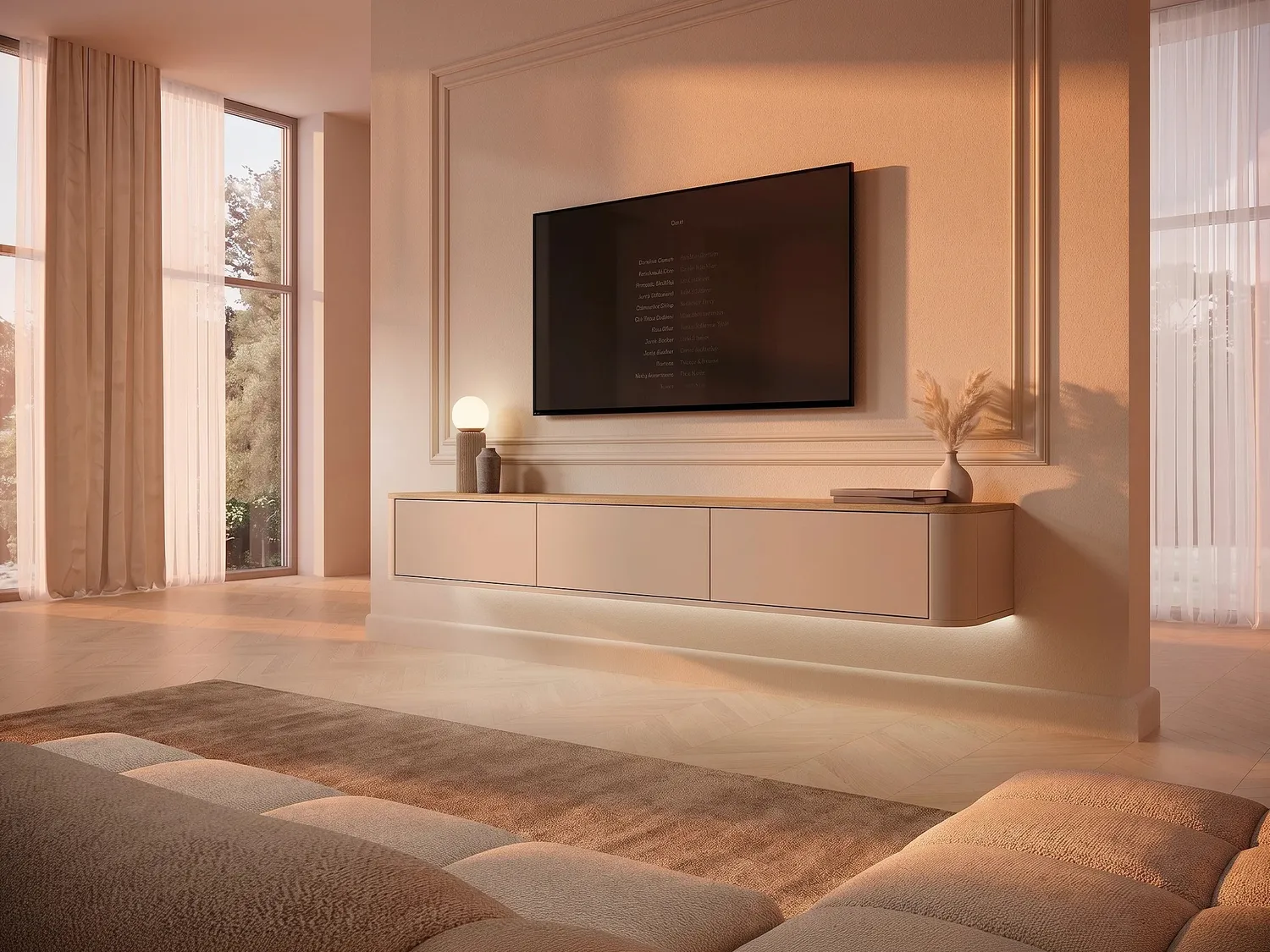
A wall-mounted TV unit draws the eye and frees up the floor space, immediately giving the impression of a more spacious living room, especially if the flooring is light coloured. By allowing light to pass underneath the unit, it lightens the wall and is particularly suitable for a small lounge or an open-plan living-kitchen area.
This lightness does not compromise practicality. A suspended TV unit can incorporate flip-up doors, closed compartments, and sections to hide boxes, consoles, and cables. The key is to check the width, depth (usually around 35 to 45 cm), and load capacity, especially if the screen rests on the surface. Choosing this type of furniture requires a suitable wall. A load-bearing concrete or brick wall supports the weight better than a lightweight partition, which is why it's advisable to fix the location from the outset, as it will be more difficult to move later than a model on legs.
TV Stand on Legs: Stability and Spacious Storage
The TV stand on legs remains a safe choice for those seeking a stable support and generous storage capacity. Placed directly on the floor, it depends less on the wall's stability, and it's just a matter of checking the available space and the ideal height so that the screen faces the sofa comfortably.
A TV stand on legs often offers deep cabinets, drawers, and hinged or sliding doors, practical for storage. The lounge layout becomes more comfortable to use, since everything remains within reach without adding a multitude of small pieces of furniture around.
Visually, this type of furniture is anchored to a wall and serves as a base for a larger composition. For example, you can align it with a low bookshelf or extend it with a bench and some modular storage units. This solution is suitable for medium to large living rooms where you want to define the space without cluttering the room.
Impact on the perception of space and circulation
The choice between a wall-mounted TV unit and a floor-standing TV unit immediately impacts the perception of space. In a compact lounge, a wall-mounted TV unit reveals more surface area, which visually enlarges the room. It also allows for a small pouffe, a basket, or a robot vacuum cleaner to be slid underneath, contributing to a more flexible layout of the lounge.
In a large living room, a freestanding TV unit can instead help to structure the space. It creates a horizontal baseline that connects the sofa, the coffee table, and possibly the rug. The area around the TV stands out from the rest of the room, especially if the lounge is open to a dining area or a kitchen. Circulation then organises itself around this core, with clear pathways behind the sofa or between the furniture.
The chosen height for the TV unit affects the overall balance. A wall-mounted unit installed slightly higher frees up the lower part of the wall, while a low-standing unit on legs allows more space above for shelves or a large painting. In both cases, the goal remains the same: to avoid overcrowding the wall dedicated to the television and to maintain a smooth visual flow from the entrance of the lounge.
Cable, socket and equipment management
Arranging a living room isn't just about the position of the TV unit. Managing cables, power strips, and connected devices plays a key role in everyday comfort. A suspended TV unit often allows cables to pass through the wall or behind the unit, leaving the wall looking neater. Some models even feature integrated cable passages at the back, which simplifies installation.
With a TV unit on legs, there is often greater leeway to hide cables behind the furniture itself, especially if its height exceeds 40 or 50 cm. Closed cabinets offer dedicated spaces for boxes and consoles, sometimes with perforations at the back for ventilation and cable passage. In both configurations, it is useful to consider the placement of electrical outlets and antenna sockets before purchasing, to avoid visible extension cords at the front.
The issue of sound and potential home cinema equipment also comes into consideration. A wall-mounted TV unit can accommodate a soundbar placed on the top surface or mounted on the wall, while a floor-standing TV unit leaves space in its niches for speakers or an amplifier. Choosing a model suited to your needs (streaming, video games, movies, music listening) helps prevent adding elements that would unbalance the overall setup.
Style and harmony with the rest of the lounge
In terms of aesthetics, the TV unit fully contributes to the style of the living room. A wall-mounted TV unit, often with clean lines and smooth façades, fits within a contemporary or minimalist environment. It enhances a wall painted in a deep colour, a textured finish, or a graphic wallpaper, without competing with these elements.
A TV stand on legs can adopt an equally modern style, but also lends itself to warmer or vintage atmospheres. A wooden model with a slightly splayed base pairs perfectly with a fabric sofa and a textured rug. A lacquered piece with metal legs fits more into a design-style or industrial lounge. The important thing is to maintain consistency in materials and tones with the other furniture in the lounge, such as the coffee table, storage units, and seating.
The choice of colours also plays a role :
- A white wall-mounted TV unit or in a very light tone easily blends into the wall, letting the screen and accessories take centre stage.
- A dark TV unit, whether mounted or freestanding, creates a stronger visual anchor and highlights the TV area, especially if the wall is light-colored.
Adjusting this contrast to the size of the lounge and the natural light avoids creating a wall that feels too heavy in a small space.
Arrangement of the lounge according to the room layout
The living room configuration directly influences the most suitable type of TV unit. In a long and narrow living room, a wall-mounted TV unit installed on the shortest wall can help break the corridor effect by focusing the gaze on a specific area. The sofa is then positioned facing it, sometimes slightly offset, with circulation happening behind or to the side.
In an almost square lounge, a footed TV unit can serve as the base for a wider arrangement, possibly complemented by columns or shelves on each side. This layout creates a structured TV wall that balances a large corner sofa or two sofas facing each other. The living room’s layout is then built around this wall, with a centred rug and a coffee table proportioned to the whole.
If the lounge opens onto a dining room or a kitchen, the TV unit should also consider the views from the other part of the room. A suspended, more compact TV unit minimises the wall of furniture effect when looking into the lounge from the dining table. Conversely, a placed TV unit, combined with a low unit behind the sofa, can help to visually delineate two separate areas, while maintaining a consistent style.
Criteria for Choosing Between a Wall-Mounted TV Unit and a Floor-Standing TV Unit
To decide between the two options, it is helpful to review some concrete criteria. First, the nature of the wall. If you have a solid load-bearing wall and are looking for a very sleek finish, a wall-mounted TV unit becomes a serious option. If the wall is a lightweight partition, a TV stand on legs, possibly complemented by some safety fixings, will be easier to install.
Next, your storage needs tip the scale. If you own lots of equipment, games, cables and accessories that you wish to hide away, a TV unit with multiple compartments, drawers and doors often provides more options. If you prefer a very tidy living room, with essentials within easy reach but few visible objects, a wall-mounted TV unit with simple lines may be sufficient, possibly complemented by closed storage elsewhere in the room.
Finally, your lifestyle habits and the possible evolution of the sitting room also matter. A floor-standing TV unit is easier to move if you change the orientation of the sofa or if you reorganise the layout of the sitting room. A suspended TV unit requires more planning, but offers a very polished look when well positioned and complemented by a few well-balanced decorative elements.
