
Furnishing a Functional Laundry Room in a Small Space
Creating a practical laundry room within just a few square metres is entirely possible, provided you optimise every centimetre and choose suitable equipment. Clear organisation, smart storage solutions, and a well-thought-out cabinet for your washing machine can transform a forgotten corner into a genuinely functional and pleasant space. To explore the available solutions, you can already browse a dedicated selection of furniture for washing machines designed to save space.
Choosing the Right Location for a Small Laundry Room
In a compact dwelling, the laundry room is often integrated into an existing space: bathroom, kitchen, entrance or technical cupboard. Each configuration imposes particular constraints but also offers opportunities for optimisation. Installing the laundry in the bathroom allows for shared water supply and the MVHR system, while integration into the kitchen makes access to work surfaces and closed storage easier.
For a laundry area in a niche or cupboard, opt for a minimum width of 70 to 80 cm to accommodate a front-loading washing machine and leave the necessary space for door opening. A curtain, a sliding door, or hinged doors allow the appliances to be hidden when the laundry area is not in use, while maintaining the aesthetic of the main room. In a corridor, choose laundry furniture that is shallow and wall-mounted units to avoid obstructing the passage.
The ideal location should always provide good ventilation, especially if you use a tumble dryer. Make sure to leave enough clearance in front of the appliances for loading and unloading laundry without difficulty. Even in a small space, a well-thought-out setup allows you to combine functionality, ergonomics, and discretion.
Choosing the right unit for a washing machine in a small space
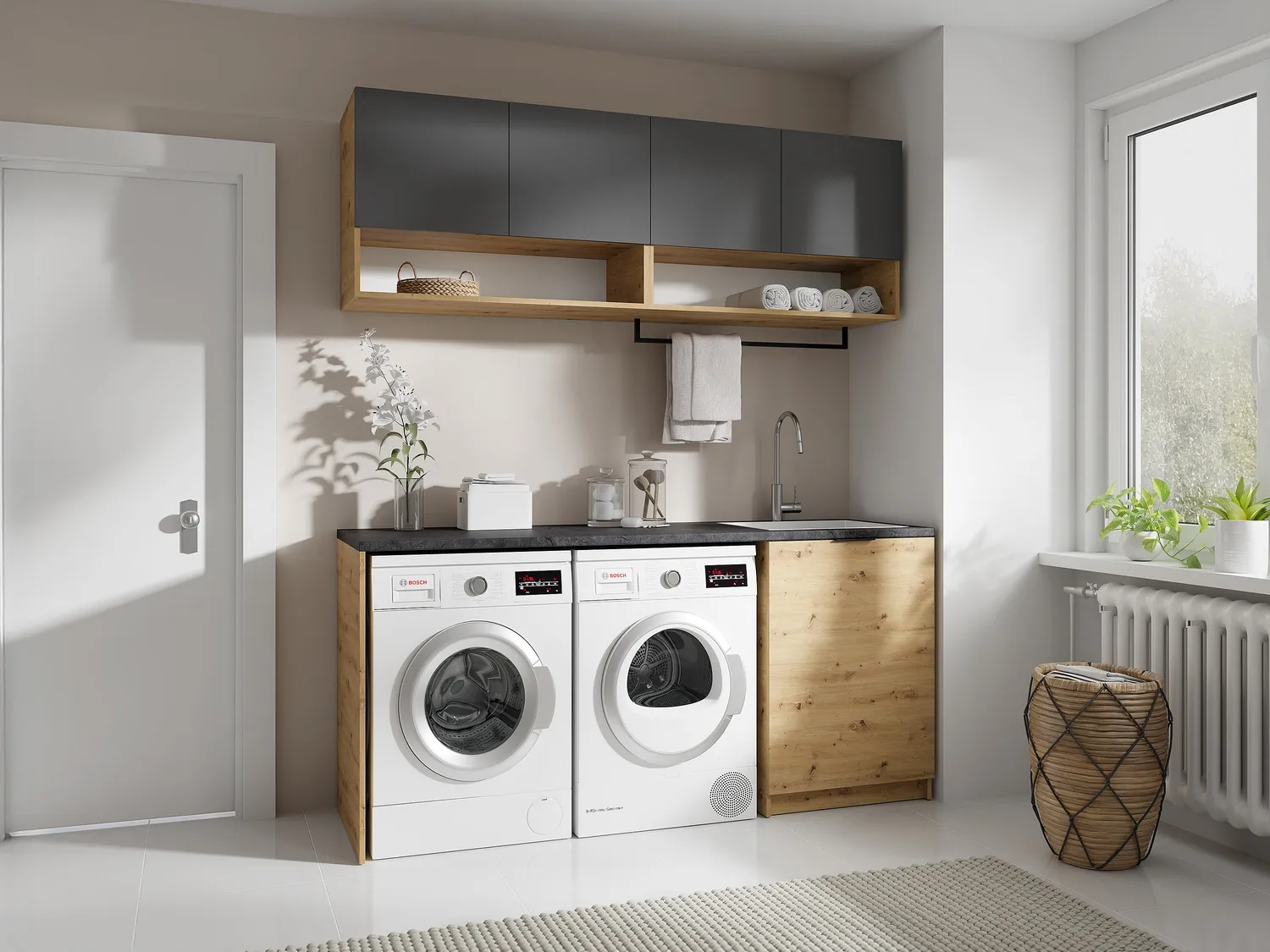
The choice of furniture for a washing machine plays a key role in optimising the utility room. This type of furniture allows you to frame or elevate the washing machine, while offering additional storage and an essential work surface for folding laundry or placing household products. In a small space, every centimetre of height counts: a suitable piece of furniture can extend up to the ceiling to maximise vertical space.
The front-loading washing machine generally has standard dimensions of around 60 cm in width, 55 to 65 cm in depth, and 85 cm in height, making it easy to integrate into a dedicated unit. Always allow a few centimetres of clearance on the sides for ventilation and connections. Some units are designed as true columns, allowing a tumble dryer to be installed above the washing machine, thereby freeing up floor space for a laundry basket or a small storage unit.
The furniture models for washing machines with drawers or doors closed under the worktop provide an aesthetic solution to hide detergents, fabric softeners, and cleaning products.
A work surface positioned between 85 and 95 cm in height offers comfortable ergonomics for handling laundry without bending too much. Depending on the room layout, you can also opt for a corner unit or a linear module complemented by wall-mounted elements. To explore ready-to-use solutions suitable for different types of machines, feel free to browse the collections dedicated to the laundry room.
Organise the laundry room storage: utilise walls and heights
In a small space, a well-thought-out laundry storage quickly transforms a cluttered room into an organised area. The idea is to maximise floor space and use the walls to install shelves, tall cabinets, and hanging accessories. Closed storage units above the washer unit allow hazardous products to be stored out of children's reach, while also reducing dust and water splashes.
Storage columns, with a width of 30 to 60 cm, are particularly useful in small spaces because they offer a large storage capacity without taking up excessive floor space. You can use them to store linen, ironing accessories, or sorting baskets. Shallow wall shelves (20 to 30 cm) are ideal for aligning bottles, jars, woven baskets, and sorting boxes, while maintaining a visually lightweight impression.
Also consider modular solutions:
- Wall Hooks for hanging sorting bags.
- Metal Bars for hanging clothes hangers.
- Perforated Rails to adjust the height of shelves over time.
These elements allow you to adapt the laundry room storage to the evolution of your needs, without undertaking major works. By combining closed storage for the items, with open storage for everyday objects, you create a space that is both functional, organised, and pleasant.
Integrate the laundry basket into a small space
The laundry basket is an essential item, but it can quickly clutter a small laundry room if not chosen carefully. To save space, opt for tall and narrow models, easy to slide between the washing machine and a wall, or under a worktop measuring 90 cm in height. Rolling laundry baskets can tuck into corners and are easy to manoeuvre to the bathroom or bedroom.
Integrated laundry basket systems within laundry furniture represent a particularly clever solution. They are hidden bins behind a door or within a drawer, which open with a tilting or sliding action, allowing you to sort laundry while maintaining a perfectly aligned façade. For example, you might plan for three separate compartments for white textiles, colours, and delicate items.
In micro-spaces, wall-mounted or hanging sorting bags under a shelf offer an alternative to the traditional basket. These fabric bags, attached to a bar or hooks, can be easily detached to transport clothes to the machine. By integrating the laundry basket into a comprehensive vertical and enclosed storage system, you avoid the “catch-all corner” effect and keep your laundry room tidy on a daily basis.
How to properly select and position the clothes airer in a small laundry room
The choice of the clothes dryer is crucial in a small space, especially if you limit the use of the tumble dryer. Classic folding models can be difficult to manoeuvre in restricted areas, which is why wall-mounted, ceiling-mounted or extendable dryers are beneficial. A clothes dryer mounted high up, above the washing machine or near a window, completely frees up the floor space and allows you to make the most of the ambient air to speed up the drying process.
The foldable drying racks, once folded, easily slip behind a door, under a piece of furniture, or in a low cupboard, which is a major advantage in a laundry room of just a few square metres. For greater comfort, always check the deployed dimensions of the drying rack: the total length of the lines, the width when open, and the height, to prevent it from obstructing passage or door operation.
If the ceiling is high enough, a pulley-mounted clothes airer is a very practical solution. It lifts above the head, freeing up circulation. Pair it with good ventilation, either natural or mechanical, to prevent humidity build-up in the room. By combining a clothes airer with a tumble dryer, you can adapt the drying capacity to your laundry volume without saturating your small space.
Optimising circulation and ergonomics in a small laundry room
A functional laundry room is not just about generous storage. Ease of movement and daily ergonomics make all the difference. In a small space, ensure there is a clear passage of at least 60 cm in front of the machines and main furniture. This allows doors to be opened, laundry baskets to be handled, and bending down without hitting other elements.
Position the washing machine unit and worktops at a comfortable height to minimise back movements. If you install a tumble dryer above the washing machine, ensure that the door remains easily accessible without the need for a step stool. Store frequently used products (detergent, stain remover, clothespins) within easy reach, and place seasonal or heavy items (duvet, beach linen...) in the upper sections of the laundry furniture.
Lighting also contributes to overall ergonomics. A direct main light, complemented by targeted lighting above the worktop or ironing corner, provides noticeable visual comfort, even in a laundry room without windows. By favouring easy-to-clean materials and light colours, you enhance the sense of space while simplifying maintenance. Result? A high-performance, pleasant technical space, designed for everyday use.
Caring for the aesthetics to create a pleasant laundry room on a daily basis
Even when it fits into just a few square metres, the laundry room deserves decorative attention. Coordinated laundry room furniture matching the bathroom or kitchen creates a pleasing visual continuity. Plain façades, discreet handles, and moisture-resistant materials (melamine, laminate, painted metal) ensure both durability and style.
Accessories play a key role in the final result:
- Natural fibre baskets for clean laundry
- Glass jars or bottles for detergents
- Labeled boxes for small accessories.
A mirror, some stylish hooks and a washable rug are enough to make the space warmer without cluttering it. By choosing a bright colour palette and adding some contrasting touches, you give the room character while keeping it calming.
Even though the laundry room remains a technical space, it is an integral part of the house. Thoughtfully designed, combining laundry storage solutions optimised, suitable washing machines and carefully selected accessories, transforms this space into a practical, pleasant area that is perfectly integrated into your daily life.
