
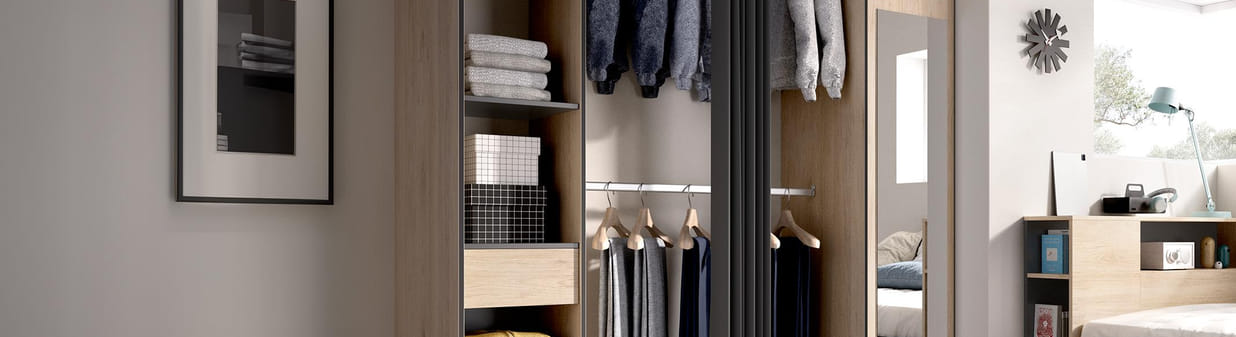
How to organise your dressing room? Tips to keep your wardrobe tidy
A well-organised dressing room is the key to starting each day peacefully. Imagine yourself rummaging every morning through a mountain of clothes, looking for that favourite shirt or pair of trousers. Stress sets in, time flies. Yet, with a few simple tips, it is possible to transform this space into a functional and soothing place.
In this article, we share practical and in-depth advice with you to transform your dressing room into a space where every item finds its place, where clutter becomes a distant memory, and where organisation rhymes with serenity.
Declutter regularly with the Marie Kondo method
Before anything else, start by doing a major clear-out by applying the philosophy of Marie Kondo, which is based on a conscious and mindful selection of the clothes you keep. The goal is to keep only what sparks joy and truly corresponds to your current lifestyle.
Ask yourself the right questions!
- Have I worn this item in the past 12 months? If not, it might be time to let it go.
- Does it still spark joy? Marie Kondo recommends taking each garment in your hands and evaluating whether it brings you a positive emotion.
- Is it in good condition? A damaged garment that is never repaired takes up space unnecessarily.
- Does it still match my current style and needs? Our tastes evolve, so it is important that our wardrobe reflects who we are today.
- Do I have duplicates? If you own several identical pieces, keep only those you actually wear.
Transform sorting into an enjoyable and structured moment
Sort by category, not by location—gather all your trousers, then all your jumpers, etc. This allows for a global vision while preventing items from being scattered. Do a clear-out at each change of season, re-evaluating your wardrobe to avoid accumulation. Express gratitude toward the clothes you donate or recycle. According to the Marie Kondo method, thanking a garment before parting with it helps you move on. Organise a fun try-on session: try on your clothes to see if you still like them, and compose new outfits with what you keep.
Use clever storage boxes
Boxes or baskets are indispensable allies for structuring a dressing room and preventing clutter. They allow you to group small accessories together while maximizing the available space in your dressing room.
Which types of boxes should you choose?
Transparent boxes are ideal for quickly viewing the contents without having to move everything. They are perfect for shoes, bags, or accessories. Fabric folding boxes offer a space-saving solution while being easy to store away when not in use. Stackable boxes exploit the height of the shelves while preventing items from scattering. Wicker or fabric baskets look great and are perfect for storing scarves, gloves, or socks while bringing a decorative touch. Finally, vacuum storage bags allow you to compress bulky clothes like coats or duvets to save space.
How to organise your boxes efficiently?
A great trick for organizing your dressing room is to label the boxes to easily find what you need. You can name them: "Winter Accessories", "Belts & Scarves", and also classify them by theme (season, type of accessory, or frequency of use).
Place rarely used boxes high up and keep daily ones within arm's reach. Bonus tip: slide lavender sachets or baking soda into boxes containing clothes to avoid bad odours and moisture.
Maximize vertical space
Walls and heights are often under-exploited. If you have a corner dressing room, exploit every nook and cranny with appropriate supports. Use the space above the rails to place storage boxes. Why not add adjustable shelves that you can move based on the evolution of your wardrobe?
Here are a few solutions you can install to maximize the storage space of your dressing room and free up floor space:
- Wall shelves: Add shelves above the rails or furniture to store storage boxes, bags, or out-of-season clothes.
- Wall hooks: Fixed on the doors or walls, they allow you to hang bags, belts, scarves, or even jewellery.
- Extra hanging rails: Install a second rail below the existing one to double the hanging space.
- Hanging baskets: Fixed under a shelf, they offer extra storage for small accessories without taking up floor space.
- Vertical shoe racks: They allow you to store several pairs without occupying too much space.
- Telescopic clothes racks: Adjustable in height, they adapt to your needs and can be folded away when not in use.
Sort by category then by colour
A well-organised dressing room is not limited to a simple stack of clothes. By adopting a classification by category and by colour, you facilitate the choice of your outfits, save time each morning, and give your wardrobe a more tidy and beautiful appearance. This method allows you to have a clear vision of what you own while preventing the accumulation of forgotten clothes at the back of drawers.
Classify your clothes by type
The first reflex for efficient storage is to group clothes by category. Storing all similar items together allows you to better visualize your options and easily access what you need. The hanging area is the ideal place to hang shirts, jackets, dresses, skirts, or elegant trousers to limit creases while optimising the available space. Shelves are more suited to t-shirts, jumpers, jeans, sportswear, and pyjamas, which can be folded and then stacked. Drawers are perfect for storing underwear, socks, or accessories such as belts or scarves, preventing them from scattering in the wardrobe. For seasonal clothes or items you wear less often, boxes or baskets are an excellent storage solution to slide onto the top shelves or under the bed.
A well-thought-out storage layout also involves organizing small accessories. Adding drawer dividers can be particularly useful to prevent them from tangling. You can also use hanging shoe organisers on the inside of doors to optimise space and keep every item within arm's reach.
Organise your clothes by colour
Once sorted by category, you can go even further by adopting a classification by colour. This method immediately gives an impression of order and visual harmony, while making the choice of your outfits easier. The eye spots different shades more easily, allowing you to put looks together faster without having to dig through messy piles.
To achieve a harmonious effect, there are several ways to organise your clothes by colour. The first consists of creating a gradient, arranging clothes from lightest to darkest. This gives a natural and soothing look while structuring your dressing room. Another approach is to follow the order of the rainbow colours, aligning your items from white to black through beige, yellow, orange, rouge, pink, purple, blue, and green. Finally, if you own a large quantity of clothes in the same shade, it can be wise to classify them by nuances.
Classify according to the season or occasion
In addition to sorting by type and by colour, you can also organise your dressing room based on seasons or occasions. This method helps gain efficiency and adapts to daily needs.
For smoother access, place clothes corresponding to the current season at the front, then store off-season items in boxes or at the top of shelves. Coats, thick jumpers, and scarves can be stored during the summer, while lighter clothes will be stored away in winter. This seasonal rotation allows you to free up space and maintain a functional dressing room all year round.
Another useful criterion for organizing your wardrobe is to classify your clothes by occasion. Separating work, casual, evening, or sports outfits makes them easier to spot and avoids mixing styles that are too different. For better readability, you can group professional clothes in a specific zone, reserve a space for comfortable weekend clothes, and organise a corner dedicated to elegant outfits for special occasions.
Finally, taking into account the frequency of use of your clothes can also improve the ergonomics of your dressing room. Place the items you wear regularly at arm's length, in the most accessible areas. Items you wear less often, like clothes for big occasions, can be stored high up or on the sides. If you want to go even further in organisation, adding discrete labels to shelves or drawers can be an excellent tip to spot each category in the blink of an eye.
Adopt uniform and suitable hangers
Hangers play a key role in the organisation of a dressing room. Choosing the right models allows you not only to save space but also to prevent clothes from creasing or slipping.
- Slim velvet hangers: Non-slip and ultra-thin, they allow you to hang a maximum amount of clothes on a limited rail space.
- Multi-tier hangers: Ideal for hanging several pairs of trousers, skirts, or scarves on a single hanger without creasing them.
- Pivoting hook hangers: Perfect for hanging accessories like belts, ties, or necklaces.
- Wooden hangers: As robust as they are aesthetic, they are recommended for coats and jackets.
- Extendable hangers: Modular, they adjust to the width of the garments while optimising space.
- Clip hangers: Indispensable for skirts or trousers, they prevent creases and hold clothes securely in place.
To organise your hangers well, you can classify your clothes by type and by colour for a clearer view. Remember to leave a small space between each hanger to prevent clothes from creasing. Use specific hangers for each category of clothes (e.g., clips for skirts, velvet for shirts, wood for coats). Group clothes by season and place those you use most often within arm's reach.
Storage tip: Invest in extra hooks to hang outfits that are ready to be worn and save time in the morning.
