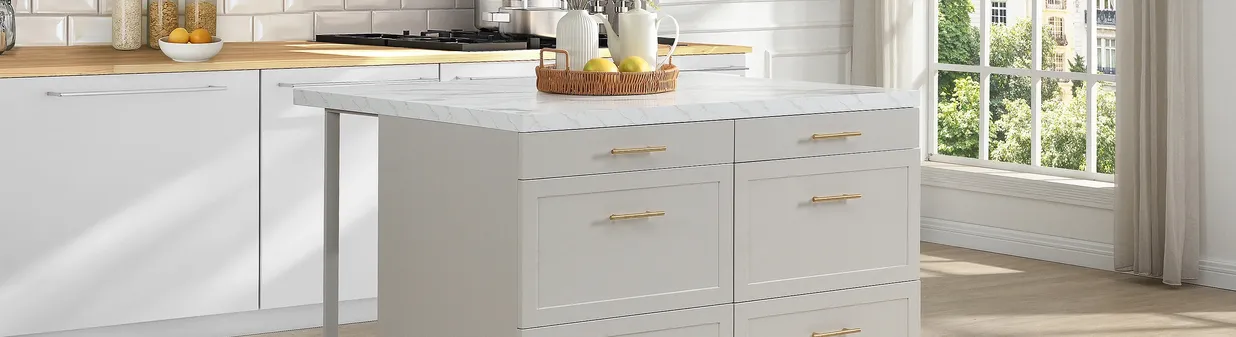
Mobile island or serving area: which solution for a kitchen without major works?
Transforming your kitchen without undertaking major renovation works is becoming increasingly popular. When space is limited or budgets are tight, a mobile kitchen unit becomes a practical and easy-to-integrate solution. Two options stand out: mobile kitchen island and a kitchen trolley. Both allow you to improve daily comfort, including in the layout of a small kitchen. Between a compact kitchen island and a lighter trolley, the choice mainly depends on usage and available space.
Why choose a mobile furniture unit in the kitchen?
Choosing a mobile kitchen unit allows you to rethink the organisation without altering the existing setup. The installation remains simple and quick, with no complex works or connections needed. Renting it offers an ideal solution to optimise space without permanent modifications.
A mobile kitchen island usually measures between 80 and 140 cm in length, with a depth of 50 to 70 cm. The standard height is around 85 to 95 cm to align with the existing worktop. A kitchen sideboard, on the other hand, remains more compact with a width of 40 to 80 cm and a depth often less than 50 cm.
The mobile kitchen island: a truly versatile space
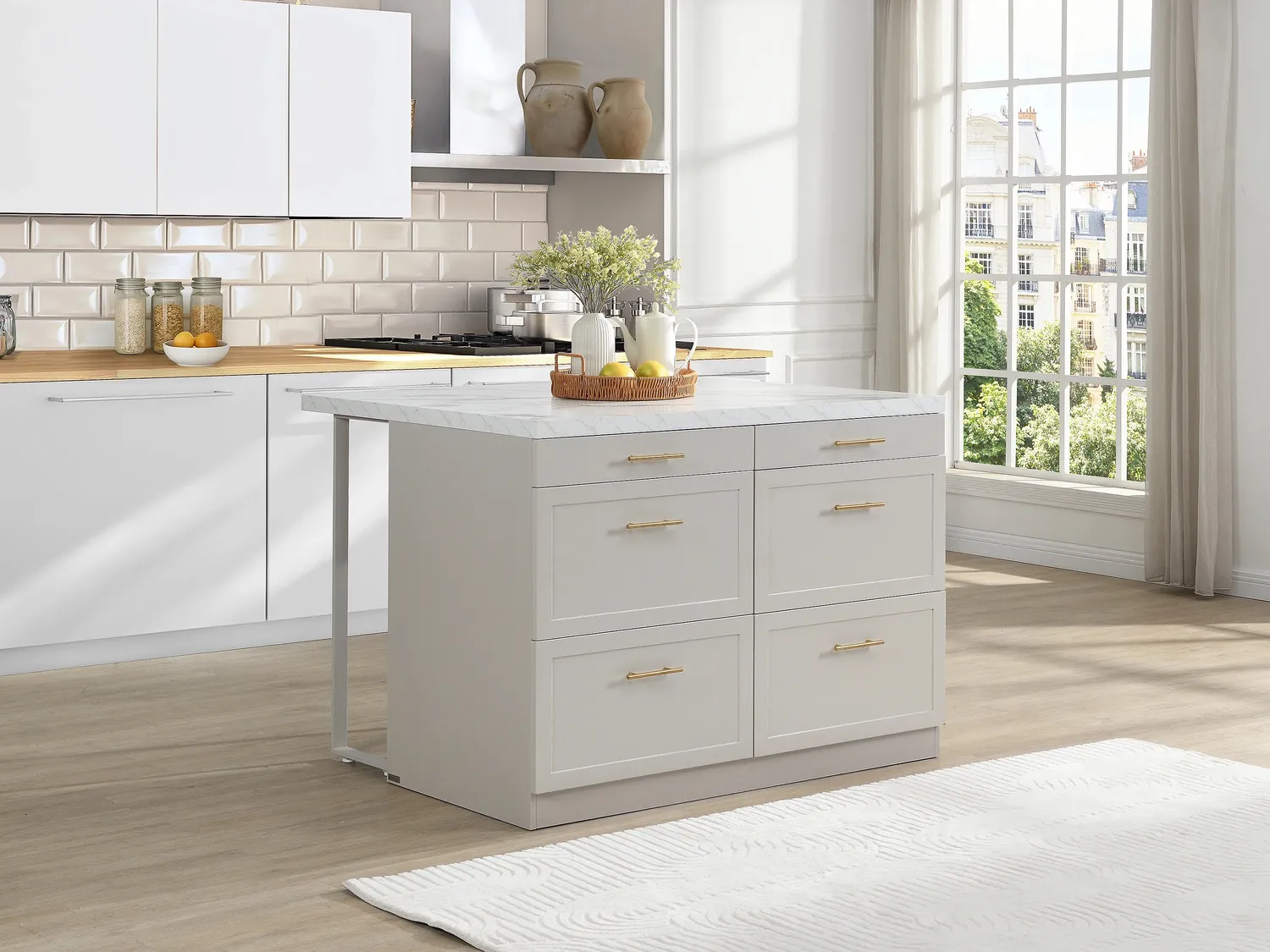
The mobile kitchen island stands out for its ability to structure the space. It is not just an additional piece of furniture, but a central element that can transform the use of the room:
- Surface gain of work area: In a confined kitchen, having an extra 60 to 100 cm significantly improves comfort when cooking. Some models feature extendable or foldable trays, allowing the surface to be enlarged according to needs. A particularly practical solution during longer or more elaborate preparations.
- Built-in storage: unlike a simple trolley, the mobile island offers more extensive storage solutions: deep drawers for bulky utensils, open shelves for quick access to ingredients, closed cabinets to hide small appliances, integrated bottle racks to optimise space. This storage capacity makes it a valuable ally in designing a small kitchen where every centimetre counts.
- Family-friendly function: the mobile island also becomes a space for daily sharing. Thanks to a slightly overhanging surface (about 25 to 30 cm), it can accommodate two to four stools. This setup transforms the kitchen into a real living space, ideal for quick meals as well as more informal moments.
The Kitchen Diner: A Compact and Flexible Solution
More discreet than an island, the kitchen trolley is appreciated for its lightness and ease of use. It easily integrates into confined spaces or as a complement to existing layout, without weighing down the room. To add a practical surface without altering the overall arrangement, it may be relevant to opt for an kitchen trolley suitable.
A mobility designed for everyday life
Mounted on swivel castors, often equipped with brakes, the trolley moves easily from one area to another. It adapts to the needs throughout the day: close to the worktop during preparation, moved to free up space, or used as an additional surface during meals. Weighing generally between 10 and 25 kg, it remains easy to handle, even in limited spaces.
An ideal compact format for small spaces
In a small kitchen, the sideboard offers an excellent compromise between functionality and limited space. Its narrow width, sometimes around 30 cm, allows it to be installed in often underused areas, such as between two pieces of furniture or along a narrow wall. Some models include fold-down trays, enabling temporary surface area expansion, from approximately 40 cm to nearly 70 cm in depth.
Accessible and Well-Thought-Out Storage Solutions
The sideboard favours open or semi-open storage solutions, which facilitate access to everyday objects. Overlapping shelves to organise products, side bars for hanging dishcloths or utensils, removable bins for fruits and vegetables, or small drawers for accessories. Each element is designed for quick and practical use. This visible organisation makes the sideboard particularly intuitive to use.
Mobile Island or Desserte: How to make the right choice?
The choice between a mobile kitchen island and a kitchen trolley primarily depends on the usage as well as the layout of the room.
Analysis of available space
A mobile island requires sufficient clearance space. It is recommended to keep at least 90 cm around the unit to move comfortably. In a kitchen of less than 10 m², a trolley often remains more suitable. It avoids visually overcrowding the room while offering additional functionality.
Definition of needs
Beyond the surface of the room, the choice between a mobile kitchen island and a kitchen trolley mainly depends on how the kitchen is used on a daily basis.
Some situations make it easier to target the most suitable piece of furniture:
- Intensive culinary preparation : favour a mobile island.
- Occasional storage needs : opt for a serving trolley.
- Occasional dining space : choose an island with a overhang.
- Flexible usage : select a lightweight serving trolley.
Style and Integration
The design also plays an important role. A mobile island becomes more visually imposing, while a sideboard becomes more discreet.
Materials vary depending on the models :
- Solid wood for a cosy atmosphere
- Metal for an industrial style
- Glossy finish for a contemporary look
- Stainless steel top for heavy-duty use
Redesign your kitchen without any building work using mobile furniture
Fitting out a worktop-free kitchen relies on choices that are both practical and adaptable. The mobile furniture transforms the space without technical constraints, while improving daily organisation. Well positioned, it can even recreate a more fluid activity triangle between the sink, the hob, and the fridge.
Simple tips to optimise space
In a renovation-free kitchen, some well-thought-out adjustments are enough to make everyday life smoother. Positioning, colour or mobility of the unit: a few simple tweaks allow you to make full use of a mobile kitchen unit.
- Position the mobile island near the preparation area to minimise mobility
- Use a trolley as an extension of the work surface during meals
- Utilise the casters to adapt the configuration according to different times of the day
- Choose models equipped with brakes to ensure stability
- Opt for light colours in a small kitchen to visually enlarge the space
A modularity that adapts to usage
The main advantage of mobile furniture lies in its ability to evolve with your needs. A mobile kitchen island can serve as a work surface during the week, then transform into a convivial table at the weekend. Similarly, a kitchen trolley easily becomes an extra bar or additional support during dinner. This flexibility helps to avoid fixed and costly layouts, while maintaining a functional space for everyday use.
Mistakes to Avoid for a Successful Layout
Even with a mobile kitchen unit carefully chosen, a few missteps can reduce the efficiency of the layout. Anticipating these points allows you to create a space that is both practical, balanced, and pleasant to live in.
- Ignore the dimensions and hinder circulation.
- Choose furniture without a secure braking system.
- Underestimate storage needs.
- Opt for materials that are difficult to maintain.
- Visually overload a small kitchen.
An accessible and scalable solution
The success of the mobile kitchen island and the kitchen trolley lies in their ability to adapt to current constraints: limited space, a restricted budget, and the need for daily flexibility. Without requiring any construction work or immobilising the room, these pieces of furniture provide an immediate transformation of the space and improve circulation between different kitchen zones.
These furniture pieces also have the advantage of adapting to the evolving needs of the household. They are easily movable, can find their place in a new kitchen layout, or change function over the years. They effortlessly transition from a dining space to an additional storage area. A clever way to invest in sustainable arrangements without feeling locked into a definitive choice.