DIY for beginners: the essential tools you need in your toolbox
Getting started with DIY is an exciting and rewarding adventure. Whether you are an amateur wishing to learn the basics or a future handy person looking for independence, getting properly equipped is essential. With the right tools, you will not only be able to carry out simple repairs but also undertake more ambitious projects with complete confidence.
DIY is not just about mounting a shelf or assembling furniture; it is also a way to express your creativity and personalise your interior. However, faced with the multitude of tools available on the market, it can be difficult to know where to start. What are the must-have tools? How do you build a toolbox adapted to a beginner's needs?
In this article, we present a list of essential DIY tools to get you off to a good start. Whether you need to measure, cut, fix, or assemble, we have selected the indispensables to have close at hand so you can complete all your projects safely and efficiently.
Measuring and marking tools
Before throwing yourself headfirst into any DIY project, getting precise measurements is crucial. An error of just a few millimetres can lead to a wobbly assembly or laborious adjustments. Measuring and marking tools help you guarantee accurate and well-aligned work right from the start. Here are the essentials that every beginner must have on hand.
- The tape measure: A tape measure is indispensable for measuring accurately before any cutting or fixing. Opt for a robust 3 to 5-metre model equipped with a locking system to avoid reading errors. Favour a model with clear and legible markings, and if possible, an ergonomic casing for a better grip.
- The spirit level: Alignment is essential for successful installations. A spirit level allows you to check that your shelves, frames, or furniture are perfectly straight. Laser levels are also available, offering increased accuracy and making it easier to work over long distances.
- The try square: Whether you need to draw straight lines or check the angle of your cuts, a carpenter's try square is a fundamental tool. It guarantees perfect 90-degree angles, which are indispensable for assembling furniture and other constructions requiring a vital attention to detail.
Cutting tools
Whether for cutting down materials, adjusting parts, or creating specific shapes, cutting tools are essential to any DIY project. The right equipment allows you to work skillfully and safely. Here are the must-have tools for clean and efficient cuts.
- The utility knife (Stanley knife): A utility knife is a versatile tool that easily cuts cardboard, plastic, or thin coverings. Favour a retractable blade model for increased safety and make sure you have spare blades within reach to maintain a clean, precise cut.
- The hand saw: A hand saw is ideal for cutting wood, PVC, or other soft materials. There are several types available:
- Handsaw (panel saw): Perfect for quick, straight cuts.
- Tenon saw: Equipped with a metallic stiffening rib, it offers a more precise cut.
- Hacksaw: Designed for cutting metal tubes and rods. Choose the saw best suited to your project to get optimal results. Depending on your needs, choose between a fine-toothed saw (for accuracy) or a coarse-toothed saw (for fast cuts).
- The jigsaw: For more complex or curved cuts, a jigsaw is an essential power tool. It allows you to cut wood, plastic, and certain metals with accuracy. Opt for a model with a variable speed drive and an anti-vibration system for better user comfort. Using blades adapted to the material you are working on is vital to guarantee a clean cut without splintering.
Fixing tools
Once your materials are cut and prepared, it is time to assemble them securely. Fixing tools are indispensable to guarantee the stability and durability of your creations. Whether for nailing, screwing, or fastening elements together, here are the tools that every beginner DIYer must have in their toolbox.
- The hammer: A hammer is the basic tool for driving nails, dismantling components, or assembling pieces. There are several types of hammers adapted to different uses:
- Joiner's hammer: Ideal for driving and removing nails thanks to its curved claw.
- Carpenter's hammer: More robust, perfect for heavy-duty work.
- Rubber mallet: Used to adjust components without damaging them, particularly when laying coverings. Choose the right hammer based on your project for more efficient and precise work.
- The screwdriver: For assembling furniture or tightening screws, a screwdriver set is indispensable. Opt for a set that includes:
- Flathead screwdriver: Useful for slotted screws.
- Phillips screwdriver: Designed for cross-head screws, which are the most common.
- Interchangeable bit screwdriver: Practical for adapting to different types of screws without multiplying your tools. A good screwdriver offers a comfortable grip, and a magnetised tip can make screwing in tight spaces much easier.
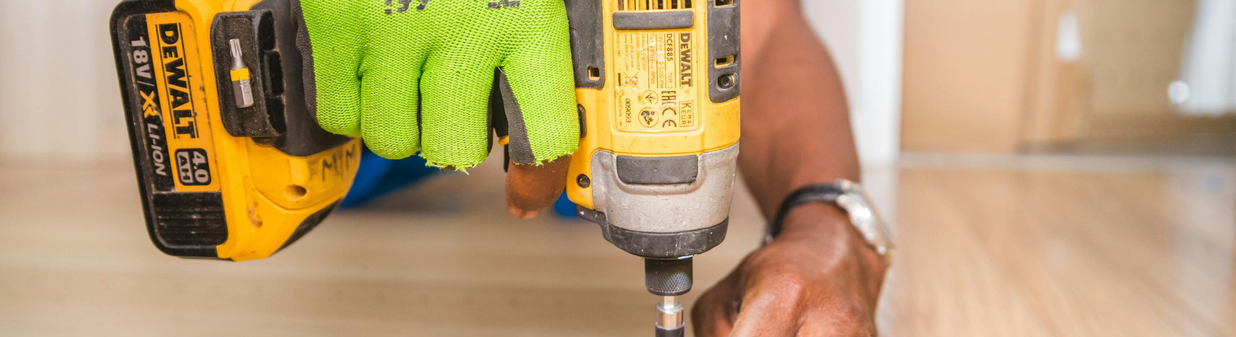
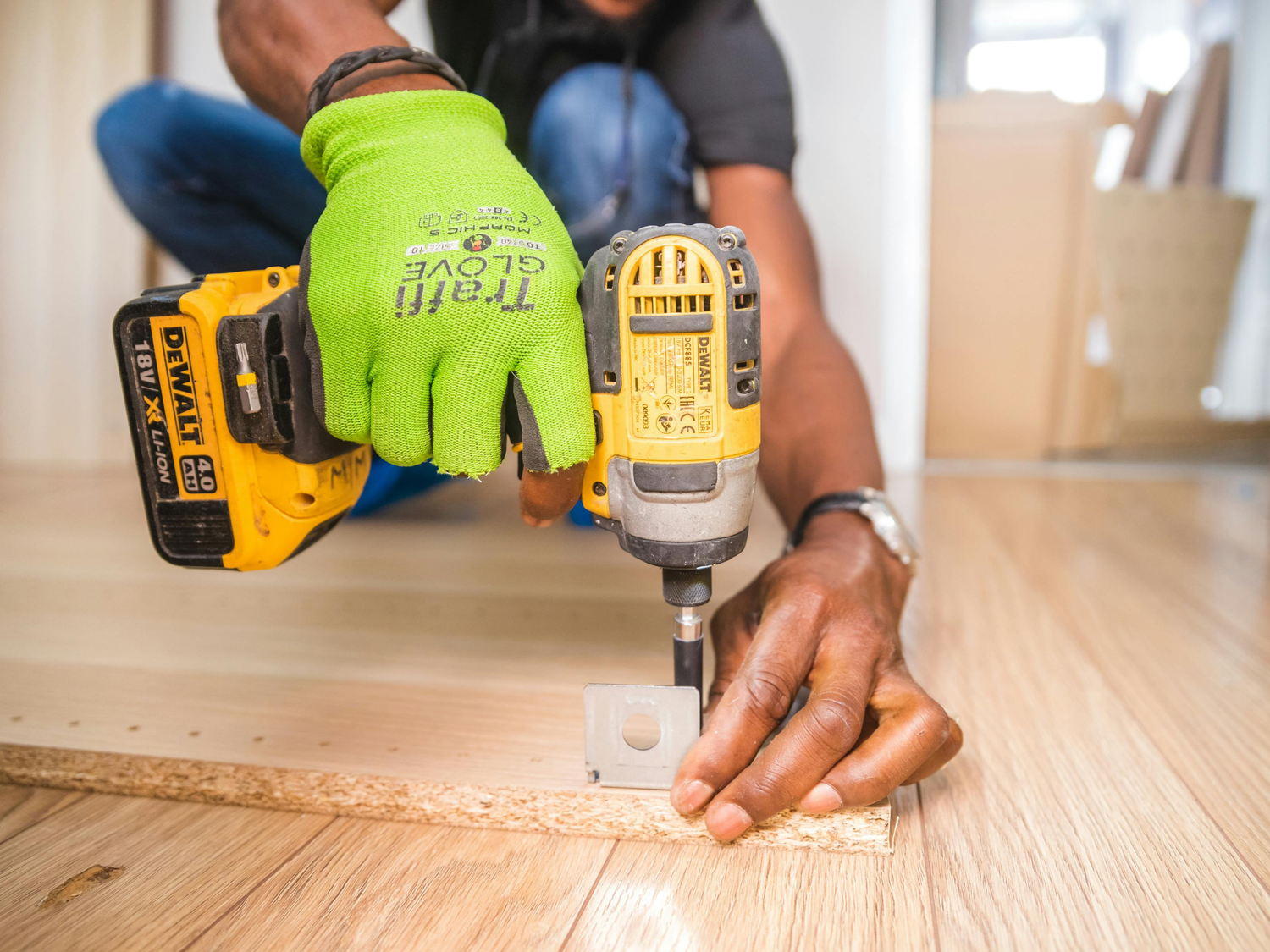
- The electric cordless screwdriver: To save time and avoid unnecessary effort, a cordless screwdriver is an excellent investment. It allows you to drive and remove screws quickly, even in tough materials. When choosing a cordless screwdriver, make sure to:
- Opt for a rechargeable battery offering good run time.
- Choose a model with a variable speed trigger to adapt to different materials.
- Use high-quality bits to avoid premature wear on the screws. A well-chosen cordless screwdriver will make your task easier on most of your DIY projects.
Clamping and gripping tools
When working on a DIY project, it is often necessary to hold pieces in place to ensure a precise and secure assembly. Clamping tools are therefore indispensable to prevent your materials from moving during drilling, screwing, or gluing.
- The slip-joint pliers (water pump pliers): Slip-joint pliers are a versatile tool designed for gripping, clamping, and turning various objects, notably nuts and pipes. Thanks to its adjustable jaw system, it adapts to different sizes, making it an excellent choice for many household jobs. Make sure to choose pliers with non-slip handles for optimal comfort and control.
- The adjustable spanner (wrench): An adjustable spanner is ideal for tightening and loosening bolts and nuts of various sizes without needing a full set of fixed spanners. Its adjustment mechanism allows for quick adaptation to various dimensions, making it indispensable for repairs and assemblies.
- The vice: A vice is an extremely useful clamping accessory for holding a workpiece securely in place during sawing, drilling, or filing. There are fixed models and portable ones, depending on the workspace you have available. A good vice ensures increased stability and reduces the risk of mistakes, allowing you to work with more precision and safety.
Drilling tools
Drilling materials is an essential task in DIY, whether it is for anchoring furniture, mounting a shelf, or assembling wood and metal components. A good drill, accompanied by the right drill bits, allows you to achieve precise and durable results. Here are the must-have tools for drilling efficiently and safely.
- The electric drill: An indispensable tool for drilling wood, metal, plastic, and even concrete. Favour a model with multiple speeds and a hammer action system if you need to drill into hard surfaces. The criteria to consider when choosing your drill include:
- Corded vs. Cordless: A cordless drill offers more mobility, while a corded model ensures continuous power.
- Drilling capacity: Check the maximum drilling diameter according to your needs.
- Ergonomics and weight: A lightweight, well-balanced drill reduces fatigue during work. A good model will allow you to complete tasks precisely and effortlessly.
- Drill bits and driver bits: A drill alone is not enough; it must be equipped with the right drill bits to adapt to different materials. The essential types of drill bits are:
- Wood drill bits: Featuring a sharp centering point for a clean, precise hole.
- Metal drill bits: Made of high-speed steel (HSS) to cut through metallic surfaces.
- Masonry drill bits: Featuring a tungsten carbide tip, designed for hard surfaces like stone or concrete. As for driver bits, it is recommended to have a varied set (flat, Phillips, Torx, hexagonal) to adapt to all types of screws.
Essential accessories
In DIY, it is not enough just to have the right tools to succeed in your projects. It is also vital to equip yourself with accessories that guarantee comfort, precision, and safety. These small pieces of equipment can make all the difference by facilitating your work and reducing the risk of accidents.
- The site light (work light): Good lighting is paramount for working with precision, especially in poorly lit spaces or outdoors. A powerful, portable work light allows you to see details clearly and avoid cutting or assembly errors. Favour a rechargeable LED or corded model depending on your needs.
- Protective gloves: To avoid splinters, cuts, and burns, protective gloves adapted to your work are indispensable. Depending on the type of activity, opt for leather gloves for heavy-duty work, latex gloves for handling chemicals, or anti-cut gloves for tasks requiring more precision.
- Safety goggles: When cutting, drilling, or sanding, small debris can be projected and could hit your eyes. Robust, well-fitting safety goggles are essential to avoid any accidents. For more comfort, choose an anti-fog and anti-scratch model.
The world of DIY is waiting for you! Starting out does not require an overloaded toolbox; a few well-chosen DIY tools are enough to complete numerous projects. With these essentials close at hand, you will be ready to repair, create, and arrange with ease.